Table of Contents
- Why Cabinet Refinishing for Property Investors Makes Financial Sense
- Cost of Cabinet Refinishing vs Replacement: A Real Numbers Breakdown
- Durable Cabinet Finishes for High-Turnover Rentals
- How Long Does Cabinet Refinishing Take for a Rental Unit?
- DIY vs Professional Cabinet Refinishing for Investors
- Tax Implications and BRRRR Integration for Cabinet Refinishing Projects
- Project Management Tips for Remote Property Investors
- Conclusion: Is Cabinet Refinishing the Right Move for Your Rental Portfolio?
Last Updated: May 18, 2026
Cabinet refinishing for property investors is one of the most financially efficient upgrades you can make to a rental or flip property, yet most investors either skip it entirely or spend three times more than necessary on full cabinet replacement. At Denver Cabinet Painting Colorado, we’ve worked with residential and commercial clients across the Denver metro for 40 years, and the pattern is consistent: investors who prioritize kitchen aesthetics before listing or re-tenanting see faster occupancy and stronger appraisal results. Below, we’ll show you exactly how to evaluate refinishing against replacement, choose the right finish for high-turnover rentals, and integrate this upgrade into a BRRRR rehab budget without blowing your numbers.
Here’s what most guides get wrong: they treat cabinet refinishing as a cosmetic luxury rather than a capital decision. For investors, it’s neither. It’s a cost-control mechanism that directly affects tenant quality, vacancy rates, and appraised value. The five strategies we cover have helped rental portfolio owners across Colorado transform dated kitchens without the capital expenditure of full replacement.
Why Cabinet Refinishing for Property Investors Makes Financial Sense
Outdated cabinets are one of the first things prospective tenants notice, and one of the last things investors budget for correctly. Cabinet refinishing for property investors works because it addresses the highest-visibility element of a kitchen at a fraction of the cost of new cabinetry.
The kitchen remains the most scrutinized room during rental showings and appraisals. According to National Association of Home Builders research on kitchen renovation impact, kitchen updates consistently rank among the improvements most likely to influence buyer and renter decisions. When cabinets look worn, stained, or outdated, the entire property reads as poorly maintained, regardless of what else has been updated.
How Outdated Cabinets Hurt Rental Property Value and Tenant Retention
Tenant retention is a financial metric, not just a satisfaction score. Every turnover costs an investor money in vacancy days, cleaning, repairs, and re-marketing. Kitchens with damaged or visually dated cabinets are a friction point that accelerates turnover.
The problem compounds in competitive rental markets. A prospective tenant comparing two units at similar price points will reliably choose the one with a cleaner, more modern kitchen aesthetic. Outdated cabinets signal neglect, even when the unit is otherwise well-maintained. Refinishing directly addresses this perception gap without the timeline or cost of full cabinet replacement.
ROI and Appraisal Impact: What Investors Should Expect
Cabinet refinishing is a high-ROI home improvement because the cost is low relative to the value it adds at appraisal and during tenant acquisition. Appraisers assess kitchens as part of overall property condition, and a kitchen with clean, uniformly finished cabinets supports a higher comparable value than one with peeling or visibly worn surfaces.
For investors using the BRRRR strategy (Buy, Rehab, Rent, Refinance, Repeat), the refinance step depends heavily on the appraised value. A kitchen that reads as updated, even through refinishing rather than replacement, can meaningfully influence the appraiser’s condition rating. This isn’t speculative. It’s a well-documented pattern in property management and home improvement circles that kitchen condition is weighted heavily in the appraisal process.
For BRRRR investors, cabinet refinishing is not a cosmetic line item. It’s a tool for maximizing the appraised value that determines your refinance ceiling.
Cost of Cabinet Refinishing vs Replacement: A Real Numbers Breakdown
The cost difference between refinishing and replacement is the clearest argument for refinishing in a rental context, but only if you understand what actually drives the numbers. Vague claims that refinishing costs “a fraction” of replacement don’t help you build a rehab budget or justify the line item to a lender or partner. Here is how the cost structure actually breaks down.
Typical Cost Ranges by Scope
Cost varies by market, cabinet count, finish type, and surface condition, but the following ranges reflect what professional contractors commonly quote for a standard rental kitchen with 10-20 cabinet doors and drawer fronts:
| Scope | Typical Range (10-20 door kitchen) | What Drives the Cost |
|---|---|---|
| Professional refinishing (paint system) | $900-$2,500 | Surface prep hours, number of coats, finish product grade |
| Professional refinishing (stain + topcoat) | $1,100-$2,800 | Wood species, grain prep, topcoat layers |
| Cabinet refacing (new doors + veneer) | $3,500-$9,000 | Door material grade, box veneer coverage, hardware |
| Full cabinet replacement (mid-range) | $8,000-$20,000+ | Cabinet line, demolition, installation, countertop adjustments |
These ranges are consistent with what professional remodeling cost trackers and contractor networks publish for mid-market U.S. metros. Your specific market will vary, but the ratio holds: refinishing typically costs 15-30% of full replacement for a comparable kitchen.
What Actually Drives Refinishing Cost
Investors who get burned on refinishing quotes usually don’t understand the three cost levers:
1. Surface preparation hours. This is the largest variable in any professional quote. A kitchen with heavy grease buildup, peeling existing paint, or water-damaged surfaces requires significantly more prep time than a clean, lightly worn kitchen. Prep can represent 40-60% of total labor hours on a refinishing job. A low quote that doesn’t account for prep is a red flag, not a deal.
2. Finish system, not just finish type. A single coat of paint is not a finish system. A durable rental-grade finish system includes a degreasing wash, light sanding or liquid deglosser, a bonding primer, two topcoats of paint or stain, and a clear protective topcoat. Each additional step adds cost and adds years to the finish life. When comparing quotes, ask specifically how many coats are included and whether a protective topcoat is part of the scope.
Cabinet Painting Service Areas in Denver & Surrounding Cities, Cabinet Refinishing in Denver County,
Serving Lakewood, CO, Littleton, CO, Golden, CO, Evergreen CO, Roxborough Park CO, Ken Carl Ranch CO,
Arvada, CO, Wheat Ridge, CO,
and Parker CO. Castle Pines CO. Englewood CO. Centennial CO.
Cabinet Painting in Arapahoe County, CO
Including Centennial, CO, Greenwood Village, CO,
Cherry Hills Village, CO, Englewood, CO,
and Aurora, CO.
Cabinet Painting in Adams County & Broomfield, CO
3. Cabinet count and configuration. Quotes are typically structured around door and drawer front count, not kitchen square footage. A galley kitchen with 24 doors costs more to refinish than an open kitchen with 14 doors, even if the galley kitchen is smaller. Get quotes based on an actual door count, not a room description.
The Real Cost Comparison: Per-Year Durability Math
The upfront cost comparison understates the financial case for professional refinishing. The more useful metric for investors is cost per year of useful finish life.
A professional refinishing job using a proper paint system with a hard topcoat, done by an experienced contractor, typically holds up through five to seven years of tenant use before requiring significant touch-up or re-coating. A DIY refinishing job or a low-bid contractor who skips prep and topcoat steps often fails within 18-24 months in a rental environment.
Using conservative estimates:
- Professional refinishing at $1,800, lasting 6 years: approximately $300/year
- DIY or low-bid refinishing at $600, lasting 18 months: approximately $400/year, and you’ve lost the vacancy time twice
- Full replacement at $12,000, lasting 15+ years: approximately $800/year, with no ROI advantage over refinishing in a mid-market rental
This per-year framing is how experienced investors evaluate the decision, not the sticker price comparison.
Where Cabinet Refacing Fits Between Refinishing and Full Replacement
Cabinet refacing is the process of replacing door fronts and drawer fronts while keeping the existing cabinet boxes in place, often combined with a veneer or laminate applied to the visible box surfaces.
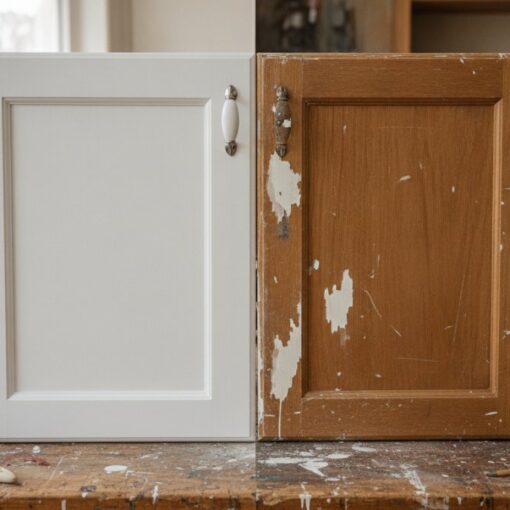
Refacing sits in the middle of the cost spectrum. It costs more than refinishing but less than full replacement, and it makes sense when cabinet doors are physically damaged beyond what paint or stain can correct but the underlying boxes are structurally sound. For most rental properties with cosmetically dated but structurally intact cabinets, refinishing is the better financial decision. Refacing becomes relevant when door fronts are warped, delaminating, or broken.
The decision tree for investors:
- Structurally sound cabinets, cosmetic issues only: Refinishing
- Damaged doors but solid boxes: Refacing
- Damaged boxes, poor layout, or full kitchen renovation: Replacement
Before accepting any quote, ask the contractor to walk through their prep steps line by line. The prep scope tells you more about finish durability than the finish product name does. A $2,200 quote with full prep will outperform a $1,100 quote that skips it, every time, in a rental environment.
This framework keeps capital expenditure proportional to actual need, which is the core discipline of rental property management. Over-spending on replacement when refinishing would have achieved the same appraisal and tenant outcome is one of the most common ways investors erode their rehab margins.
Durable Cabinet Finishes for High-Turnover Rentals
Durable cabinet finishes for high-turnover rentals are not the same as finishes appropriate for an owner-occupied home. In a rental context, the finish must withstand repeated cleaning, humidity fluctuations, and the variable care habits of rotating tenants. Choosing the wrong finish is one of the most expensive mistakes an investor can make, because a finish that chips or yellows within 18 months means refinishing the cabinets again before the next tenant cycle.

Paint vs Stain vs Gel Stain: Choosing the Right Finish for Rental Wear
Each finish type has a distinct durability profile in high-use environments.
Paint with a polyurethane topcoat is the most durable option for rental cabinets. A properly applied paint system, sanded between coats and sealed with a hard polyurethane finish, resists moisture, cleaning products, and surface abrasion better than stain alone. White and light gray tones also photograph well, which matters for listing photos.
Stain penetrates the wood grain and provides a natural look, but it requires a clear topcoat to be durable. Without proper sealing, stain absorbs grease and moisture over time. In a rental kitchen, this accelerates wear significantly.
Gel stain is a middle-ground option that sits on the surface rather than penetrating the wood, making it useful for cabinets made from non-porous materials or for achieving a wood-tone look over previously painted surfaces. It’s more durable than traditional stain in high-contact areas but requires careful application to avoid streaking.
For most rental properties, a professional-grade paint system with a hard topcoat is the right call. The finish lasts longer between touch-ups, cleans more easily, and reads as modern to prospective tenants.
Hardware Replacement and Door Fronts: Small Upgrades, Big Impact
Hardware replacement is the most cost-effective single upgrade in a cabinet refinishing project. New pulls and knobs on freshly refinished cabinet doors create a complete visual transformation at minimal cost. Matte black and brushed nickel hardware are currently the most durable in rental settings because they show fewer fingerprints and resist surface wear better than polished chrome.
Door replacement within a refinishing project, replacing only the most visibly damaged doors while refinishing the rest, is a targeted approach that controls costs while addressing the worst cosmetic issues. This is not full refacing. It’s selective door replacement as part of a refinishing scope, and it’s a practical option for investors managing tight rehab budgets.
When ordering replacement hardware for a rental, buy 10-15% more than you need and store the extras. Hardware lines get discontinued, and having matching spares prevents mismatched replacements after tenant turnover.
How Long Does Cabinet Refinishing Take for a Rental Unit?
Cabinet refinishing for a standard rental kitchen takes two to four days for a professional crew, depending on cabinet count, finish type, and the condition of existing surfaces. This timeline assumes proper preparation, which includes cleaning, degreasing, light sanding, and priming before any finish is applied.
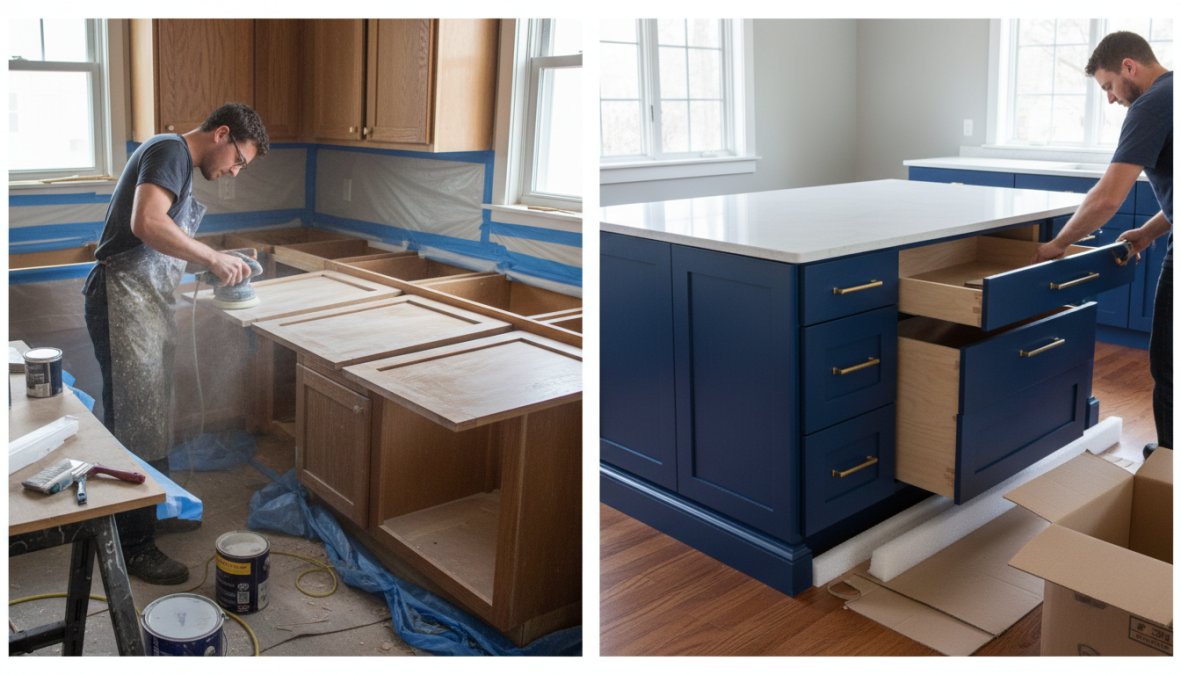
The preparation phase is where most DIY attempts and low-quality contractors fail. Skipping or rushing prep produces a finish that looks acceptable on day one and fails within months. A professional crew with the right equipment, proper ventilation, and a structured drying schedule between coats will consistently outperform a rushed job regardless of the finish product used.
For investors managing vacancy, the two-to-four-day window is a significant advantage over full replacement, which typically requires two to three weeks including ordering, delivery, demolition, and installation. Refinishing keeps the unit out of inventory for a fraction of the time.
According to Remodeling Magazine’s annual Cost vs. Value report, minor kitchen remodels consistently return a higher percentage of their cost than major renovations, which supports the case for refinishing over replacement in investment properties.
DIY vs Professional Cabinet Refinishing for Investors
The honest answer is that DIY cabinet refinishing rarely makes financial sense for investors with more than one property. The time cost, equipment requirements, and skill threshold for a durable, consistent finish are higher than most people anticipate.
Pros and Cons of Each Approach for Rental Portfolio Management
DIY Refinishing
Pros:
- Lower direct material cost
- Flexible scheduling on owner-managed properties
- Useful for small touch-up work between tenants
Cons:
- Requires spray equipment or high-quality brush technique to avoid visible brush marks
- Prep work is time-intensive and easy to rush
- Inconsistent results on large cabinet runs
- A poor finish fails faster, creating a repeat cost within 12-18 months
- Time cost is significant for investors managing multiple units
Professional Refinishing
Pros:
- Consistent, smooth finish across all surfaces
- Faster turnaround with proper equipment
- Durable results that hold up through multiple tenant cycles
- Prep work done correctly the first time
- Free quotes available from experienced contractors like Denver Cabinet Painting Colorado
Cons:
- Higher upfront cost than DIY materials alone
- Requires scheduling coordination with a contractor
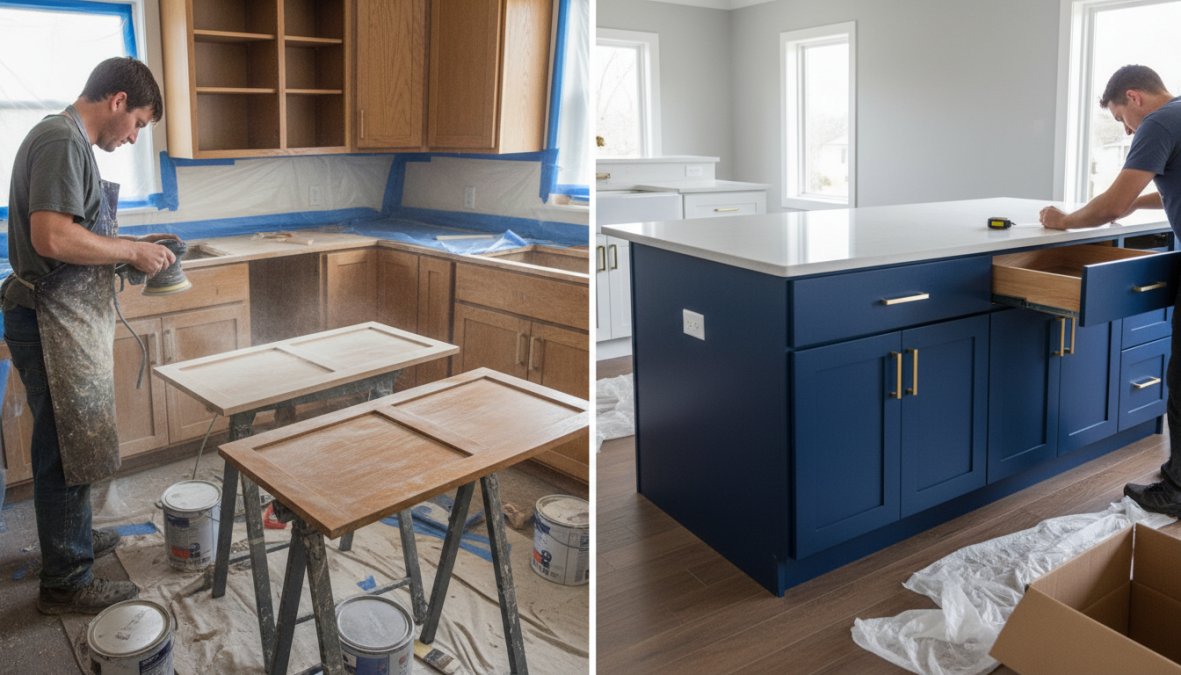
For investors managing a rental portfolio, the math almost always favors professional refinishing. A finish that lasts five to seven years through multiple tenancies costs less per year than a DIY finish that requires redoing after 18 months.
Avoid contractors who skip the priming step or apply finish directly over existing paint without sanding. This is the most common cause of peeling finishes in rental properties, and it typically voids any workmanship guarantee.
Tax Implications and BRRRR Integration for Cabinet Refinishing Projects
This is the section most investor guides skip entirely, and it’s where the financial picture gets meaningfully more complex, and more favorable, than a simple cost comparison suggests. Understanding how cabinet refinishing is classified for tax purposes, and how it connects to the refinance appraisal in a BRRRR cycle, can change the effective cost of the project significantly.
Is Cabinet Refinishing a Repair or a Capital Improvement?
The IRS draws a meaningful line between a repair and a capital improvement for rental property owners, and which side of that line your cabinet project falls on determines whether you deduct the full cost this year or depreciate it over time.
Under IRS guidance (specifically the Tangible Property Regulations, which govern how landlords treat building costs), a cost is generally a deductible repair if it:
- Restores the property to its ordinary operating condition
- Does not add significant new value or extend the useful life of the asset beyond its original expected life
- Does not adapt the property to a new or different use
A cost is generally a capital improvement (depreciable over time) if it:
- Betters the property by fixing a pre-existing defect or condition
- Restores a major component to like-new condition
- Adapts the property to a new use
Where cabinet refinishing typically lands: Refinishing existing cabinets, cleaning, sanding, priming, and repainting or restaining surfaces that are cosmetically worn, is most commonly treated as a repair or maintenance expense. You are restoring the cabinets to a functional, presentable condition, not replacing a major structural component or adding new capability. Most tax practitioners and landlord-focused CPAs treat routine refinishing as a current-year deductible expense under the repair and maintenance category.
Where it can shift toward capital improvement: If the refinishing is part of a larger kitchen renovation that collectively constitutes a betterment or restoration of the kitchen as a unit, for example, new countertops, new appliances, new flooring, and refinished cabinets all done together, the IRS may view the entire project as a capital improvement to the kitchen system. In that context, the cabinet refinishing cost could be bundled into the improvement and depreciated over 27.5 years as part of residential rental property, or potentially over a shorter recovery period if a cost segregation study identifies it as a personal property component.
The practical implication for investors: A standalone cabinet refinishing project on an otherwise stable rental property is a strong candidate for a full current-year deduction. A cabinet refinishing project done as part of a comprehensive pre-listing or pre-refinance renovation may need to be evaluated more carefully with a tax professional.
The IRS Safe Harbor for Small Taxpayers and the Routine Maintenance Safe Harbor both offer additional pathways for landlords to deduct building costs that might otherwise require capitalization. Whether your refinishing project qualifies depends on your property’s unadjusted basis, your gross receipts, and the nature of the work. Review [IRS Publication 527 on residential rental property](https://www.irs.gov) and the Tangible Property Regulations (Treasury Regulation 1.263(a)) with a qualified CPA before filing. This article does not constitute tax advice.
Depreciation Timing: Why the Repair vs. Capital Distinction Matters in Real Dollars
The financial difference between deducting a cost now versus depreciating it over 27.5 years is significant, especially for investors in higher tax brackets or those with multiple properties.
Consider a $2,000 cabinet refinishing project. If it qualifies as a deductible repair:
- An investor in the 24% federal bracket saves approximately $480 in federal taxes in the year the work is performed
- The after-tax cost of the project is approximately $1,520
If the same project is treated as a capital improvement depreciated over 27.5 years:
- Annual depreciation deduction: approximately $73
- Annual federal tax savings at 24%: approximately $17
- It takes over 28 years to realize the same total tax benefit
This is not a trivial distinction. For investors running multiple refinishing projects across a portfolio in a single tax year, the aggregate difference between repair treatment and capitalization can represent thousands of dollars in current-year cash flow.
Fitting Cabinet Refinishing Into Your BRRRR Rehab Budget
In a BRRRR rehab budget, cabinet refinishing belongs in the kitchen line item alongside countertop updates and appliance replacements, but the way you sequence and document it matters for both the appraisal outcome and the tax treatment.
The appraisal connection most investors miss: BRRRR investors focus heavily on the Rehab phase but often underestimate how the Refinance appraisal is actually conducted. Residential appraisers using the Uniform Residential Appraisal Report (URAR) assess kitchen condition as part of the overall property condition rating, which directly influences the adjusted value of comparable sales. A kitchen rated C3 (well-maintained, minor deferred maintenance) versus C4 (adequate condition, some deferred maintenance evident) can affect the appraiser’s comparable adjustments by a meaningful margin depending on your market.
Refinished cabinets, when done professionally with a clean, consistent finish, support a C3 condition rating. Worn, peeling, or visibly dated cabinets push a kitchen toward C4 or lower. The difference in appraised value between a C3 and C4 kitchen condition in a mid-market rental property can easily exceed the cost of the refinishing project itself, which is the core financial logic of including it in a BRRRR rehab scope.
How to sequence the work for maximum appraisal impact:
- Complete cabinet refinishing before the appraisal inspection, not after. This sounds obvious, but investors managing tight timelines sometimes schedule the appraisal before all cosmetic work is complete. The appraiser can only rate what they see on inspection day.
- Pair refinishing with hardware replacement. New hardware on freshly refinished cabinets creates a complete visual transformation that reads as a full kitchen update to an appraiser, even though the cost is a fraction of replacement. This combination is one of the highest-ROI moves in a BRRRR rehab kitchen scope.
- Document the work with before-and-after photos and contractor invoices. If your appraiser asks about recent improvements, and many will, having documentation of the refinishing project supports the condition rating you’re targeting. It also supports your tax treatment if the project is later reviewed.
- Avoid over-improving relative to your comp set. The refinance appraisal is bounded by what comparable properties in your market support. Refinishing to a clean, neutral standard (white or light gray paint, updated hardware) hits the visual threshold that supports a favorable condition rating without spending beyond what the market will recognize in value.
The rehab budget allocation framework for cabinets in a BRRRR context:
- Assess structural condition of existing cabinets first, boxes, hinges, drawer slides
- Determine whether refinishing, refacing, or replacement is warranted based on the decision tree above
- Get itemized quotes that separate prep labor, finish materials, and topcoat, this documentation supports your tax treatment
- Compare the cost of each option against the projected appraisal impact in your specific market
- Allocate budget proportionally to your market’s rent ceiling and ARV, do not install $15,000 cabinets in a market where the ARV supports $180,000
For BRRRR investors, cabinet refinishing is not just a cosmetic line item. It is a tool for moving the appraiser’s condition rating, which determines your refinance ceiling, and when properly documented, it is likely a current-year deductible expense rather than a multi-decade depreciation schedule. Both effects improve your cash-on-cash return on the project.
Project Management Tips for Remote Property Investors
Remote investors face a specific challenge with cabinet refinishing: you can’t inspect the prep work before the finish goes on, and prep is everything. A smooth, durable finish depends entirely on the quality of the sanding, cleaning, and priming that happens before any paint or stain is applied.
The practical solution is a structured documentation requirement. Before any finish is applied, require your contractor to send photos of the prepped surfaces. This takes five minutes and eliminates the most common failure mode in remote project management.
Additional tips for remote investors managing cabinet refinishing projects:
- Use contractors with verifiable track records. Forty years of experience in a market, like Denver Cabinet Painting Colorado has in Colorado, is a meaningful signal of consistent process and quality.
- Specify the finish product and sheen level in writing. “Satin paint” is not a specification. “Benjamin Moore Advance in Satin finish with two coats of water-based polyurethane” is.
- Build a two-day buffer into your vacancy timeline. Finish cure time matters. A cabinet that’s dry to the touch is not the same as a cabinet that’s ready for daily use.
- Request a walkthrough video before sign-off. A short video of all cabinet surfaces under good lighting catches issues that photos miss.
As noted in BiggerPockets guide to remote property management, documentation and clear contractor specifications are the two highest-use habits for remote investors managing rehab projects.
Conclusion: Is Cabinet Refinishing the Right Move for Your Rental Portfolio?
Cabinet refinishing for property investors is the right move in the vast majority of cases where existing cabinets are structurally sound. It delivers a meaningful improvement to kitchen aesthetic, supports stronger appraisal results, attracts higher-quality tenants, and keeps capital expenditure proportional to actual need. The alternative, full replacement, rarely pencils out in a rental context unless the cabinets are genuinely beyond repair.
The decision framework is straightforward: assess structural condition first, then match your intervention to what the cabinets actually need. Refinishing handles cosmetic issues. Refacing handles damaged doors. Replacement handles damaged boxes. Most rental kitchens fall into the first category.
Investors managing properties across Colorado face a specific challenge: finding a contractor with the process discipline to deliver consistent, durable finishes across multiple units on a tight vacancy timeline. Denver Cabinet Painting Colorado brings 40 years of experience to exactly this problem, specializing in cabinet painting, refinishing, and glazing with an emphasis on meticulous preparation and smooth, consistent finishes. Get a free quote from Denver Cabinet Painting Colorado and put your next rehab budget to work where it actually moves the numbers.
Frequently Asked Questions
Is cabinet refinishing worth it for rental properties?
Cabinet refinishing is generally considered one of the most cost-effective kitchen upgrades for rental properties. It can significantly improve kitchen aesthetics, support higher rental rates, and reduce tenant turnover, all at a fraction of full replacement cost. For investors managing multiple units or working within a tight rehab budget, refinishing outdated cabinets often delivers strong ROI without the extended downtime of a full kitchen renovation.
How much does cabinet refinishing cost compared to full replacement?
Professional cabinet refinishing typically costs considerably less than full cabinet replacement. Refinishing a standard kitchen may range from a few hundred to a couple thousand dollars depending on cabinet count and finish type, while full replacement can run several times higher. Cabinet refacing, replacing door fronts and drawer fronts while keeping the existing boxes, falls in between. For investors, refinishing is usually the most budget-conscious path that still delivers a meaningful visual upgrade.
What is the best finish for rental property cabinets in high-turnover units?
For durable cabinet finishes in high-turnover rentals, a hard-wearing paint finish with a polyurethane topcoat is widely recommended. This combination resists scuffs, moisture, and everyday wear better than gel stain alone. Satin or semi-gloss sheens are practical choices since they’re easier to wipe clean between tenants. Avoid flat finishes in kitchens, they show wear quickly and are harder to maintain, which increases your property management costs over time.
How long does cabinet refinishing take, and how does it affect rental income?
A professional cabinet refinishing project for a standard rental kitchen typically takes two to five days, including proper sanding, priming, painting or staining, and applying a protective topcoat. This is significantly faster than full cabinet replacement, which can take one to two weeks or more. Shorter project timelines mean less vacancy and lost rental income, a meaningful advantage for investors managing occupied units or trying to minimize downtime between tenants.
Can cabinet refinishing costs be deducted on rental property taxes?
The tax treatment of cabinet refinishing depends on how the IRS classifies the work, as a repair or a capital expenditure. Refinishing existing cabinets is often treated as a repair or maintenance expense, which may be fully deductible in the year it’s completed rather than depreciated over time. However, tax rules vary and depend on the scope of work and your overall rehab activity. Always consult a qualified tax professional familiar with rental property accounting before making decisions based on tax implications.
This article was written using GrandRanker