Table of Contents
- Does Painting Kitchen Cabinets for Resale Value Actually Work?
- ROI of Painting Kitchen Cabinets Before Selling
- Best Cabinet Paint Colors for Resale: What Buyers Want
- Structural Assessment: Is Your Cabinet a Good Candidate for Painting?
- Kitchen Cabinet Painting Preparation Steps That Determine the Finish
- Cost to Paint Kitchen Cabinets Professionally vs. DIY
- How Long Does It Take to Paint Kitchen Cabinets Before Listing?
- Painting Kitchen Cabinets for Resale Value: Final Verdict
Last Updated: May 22, 2026
Painting kitchen cabinets for resale value is one of the highest-use moves a homeowner can make before listing a property. Denver Cabinet Painting Colorado has worked with hundreds of Colorado sellers who wanted to maximize their home’s appeal without committing to a full kitchen remodel. The kitchen is the room buyers scrutinize most, and cabinet condition is the first thing they notice. Below, we’ll show you exactly how to assess your cabinets, choose the right colors, understand the real ROI, and avoid the mistakes that can actually hurt your sale.
Here’s what most guides get wrong: they treat cabinet painting as a guaranteed win. It isn’t. Done correctly, it transforms a dated kitchen into a selling point. Done poorly, or on the wrong cabinets, it can raise red flags for buyers and appraisers alike. This guide covers both sides.
Does Painting Kitchen Cabinets for Resale Value Actually Work?
Painting kitchen cabinets for resale value works when the cabinets are structurally sound, the preparation is thorough, and the color selection matches current buyer expectations. The kitchen carries significant weight in home appraisal decisions, and dated cabinets are among the most common reasons buyers mentally discount a property’s worth the moment they walk in.
The logic is straightforward: buyers form first impressions within seconds of entering a kitchen. Fresh, neutral-toned cabinets signal that the home has been maintained. Worn, discolored, or visibly dated cabinets do the opposite. A clean cabinet refinishing job can shift a kitchen from a perceived liability to a genuine selling point without the cost of full cabinet replacement.
That said, painting alone isn’t magic. It works as part of a coherent kitchen aesthetic, not as a standalone fix.
How Buyers and Appraisers Evaluate Kitchen Aesthetics
Buyers evaluate kitchen aesthetics emotionally before they evaluate them rationally. They’re asking: “Can I see myself cooking here?” Appraisers, on the other hand, assess functional condition, quality of finishes, and how the kitchen compares to similar homes in the market.
According to National Association of Realtors research on home staging and kitchen updates, kitchen improvements consistently rank among the top features that influence buyer decisions. Appraisers note cabinet condition as a direct contributor to kitchen value assessments. A kitchen with freshly painted, well-finished cabinets reads as “updated” even if the appliances or countertops are several years old.
The marketability of a home with a modern kitchen appearance is meaningfully higher than one with visibly tired finishes. Prospective buyers often use cabinet condition as a proxy for how well the entire home has been maintained.
The Devaluation Risk: When Painted Cabinets Hurt Your Sale
This is the part most guides skip entirely. Poorly executed cabinet painting can actively devalue your home.
Buyers and their agents are experienced at spotting amateur finishes. Brush marks, uneven coverage, drips, or peeling paint around hardware holes signal a rushed DIY job. Worse, if a buyer’s inspector finds that paint was applied over water-damaged or structurally compromised wood, it raises questions about what else in the home might have been covered up rather than repaired.
The devaluation risk is highest when:
- Cabinets have soft spots, swelling, or water damage that wasn’t repaired before painting
- The finish is visibly uneven or shows poor surface preparation
- Bold or highly personal color choices were used that limit buyer appeal
- The painted finish doesn’t match the quality of surrounding finishes in the kitchen
The rule is simple: paint should reveal a well-maintained cabinet, not hide a failing one.
ROI of Painting Kitchen Cabinets Before Selling
Cabinet painting for resale is one of the most cost-effective pre-sale investments available to homeowners, but “cost-effective” is meaningless without context. Most guides stop at vague encouragement. This section goes further: it breaks down what the investment actually looks like, what return patterns practitioners observe across different market conditions, and why the ROI calculation changes depending on where your home sits in the price spectrum.
The return on investment from cabinet painting depends on three factors: the current condition of the cabinets, the quality of the paint job, and how the finished kitchen compares to competing listings in your price range. In markets where most homes in a given price bracket have updated kitchens, dated cabinets become a negotiating liability. Refreshed cabinets remove that liability.
What Cabinet Painting Actually Costs vs. What It Returns
Professional cabinet painting on a standard kitchen, typically 20 to 30 door and drawer faces, generally falls in a range that is a fraction of full cabinet replacement, which can run several times higher for comparable box counts. The exact figures vary by region, kitchen size, and finish complexity, but the cost-to-visual-impact ratio is consistently favorable.
The return is not always expressed as a direct price increase. More often, it shows up as:
- Fewer price reduction requests. Buyers who walk into a dated kitchen frequently use it as leverage to negotiate down. A refreshed kitchen removes that specific objection from the table.
- Faster time on market. Homes that show well in online photography, where most buyers form their first impression, tend to generate more showing requests and move more quickly. A kitchen that photographs as updated reduces the days-on-market drag that compounds into real financial cost for sellers.
- Stronger initial offers. In competitive markets, buyers competing for a well-presented home are less likely to open with a lowball offer than buyers who see obvious deferred maintenance.
Remodeling Magazine’s Cost vs. Value Report consistently shows that minor kitchen updates deliver some of the strongest returns among pre-sale renovations. Cabinet painting falls firmly in the “minor update” category by cost while delivering “major update” visual results, a distinction that matters when you’re allocating a limited pre-sale budget.
ROI Considerations by Market Type: Denver and Beyond
This is the breakdown most guides skip entirely. The ROI of cabinet painting is not uniform, it shifts meaningfully based on market temperature, price tier, and buyer expectations in your specific area.
Hot, competitive markets (Denver metro, Front Range):
In markets where inventory is low and buyer competition is high, presentation quality has an outsized effect. Buyers in competitive markets are often making faster decisions with less negotiating room, and a kitchen that reads as updated reduces hesitation. Sellers in these markets who invest in cabinet painting before listing tend to see stronger initial offers and fewer inspection-driven price adjustments. The investment is most likely to translate into a direct price premium here because competing listings are also presenting well, a dated kitchen stands out negatively.
Balanced or transitioning markets:
In markets where supply and demand are more evenly matched, cabinet painting still reduces buyer objections but the direct price impact is more modest. The more reliable return here is speed: a well-presented kitchen shortens the time between listing and accepted offer, which reduces carrying costs (mortgage, taxes, utilities) that accumulate during extended market time.
Slower or rural Colorado markets:
In markets with longer average days on market and more price-sensitive buyers, the calculus shifts again. Here, the primary value of cabinet painting is competitive differentiation, standing out among listings where many homes show dated kitchens. The investment may not produce a dollar-for-dollar price increase, but it reduces the probability of a buyer walking away entirely or requesting a large concession.
Price tier matters as much as market temperature:
In entry-level price ranges, buyers expect some cosmetic work and may not pay a premium for it. In mid-range and upper-mid-range homes, updated kitchens are expected, and dated cabinets are a genuine liability. In luxury price ranges, buyers expect full renovation quality, cabinet painting alone may not be sufficient without coordinated upgrades to countertops, hardware, and lighting.
The strongest ROI scenario: a mid-range home in a competitive market where the cabinet boxes are solid, the existing color is dated or highly personal, and competing listings have updated kitchens. In this scenario, cabinet painting moves the home from “needs work” to “move-in ready” in buyer perception, a shift that consistently supports asking price integrity.
How Cabinet Painting Compares to Full Kitchen Remodel Costs
A full kitchen remodel typically involves new cabinet boxes, new countertops, new appliances, and new flooring. The cost is substantial, and the timeline can stretch weeks or months, which creates complications when a home is actively listed.
Cabinet painting occupies a completely different cost tier. Professional cabinet refinishing delivers a comparable visual impact to new cabinets at a much lower investment, and the turnaround time is measured in days rather than weeks. For sellers who need to move quickly or who are working within a pre-sale renovation budget, this distinction matters enormously.
The cost-effectiveness of cabinet painting is most pronounced when the existing cabinet boxes are solid and the hardware can be updated simultaneously. New cabinet hardware costs relatively little and dramatically amplifies the impact of fresh paint. The combination, fresh paint plus new hardware, is the single highest-return pairing available in a pre-sale kitchen refresh.
ROI from cabinet painting is real but context-dependent. In a competitive market with mid-to-upper price range homes, it is one of the most defensible pre-sale investments available. In slower markets or entry-level price ranges, the return shows up more in speed and reduced negotiating friction than in direct price premiums. Know your market before you set your expectations.
Best Cabinet Paint Colors for Resale: What Buyers Want
Neutral colors are the clear answer for resale-focused cabinet painting, but stopping there misses the more useful question: why do certain neutrals outperform others, and how does color interact with the rest of the kitchen and with how the home photographs online? This section covers both the what and the why, plus the integration strategy that turns a good color choice into a great listing presentation.
Why Neutral Colors Work: The Mechanism, Not Just the Rule
Buyers need to mentally move into a home before they make an offer. Color is one of the most powerful triggers of either friction or ease in that mental exercise. Highly saturated or personal colors force a buyer to first imagine repainting before they can imagine living there, and that cognitive step, however brief, introduces doubt.
Neutral cabinet colors work for three distinct reasons:
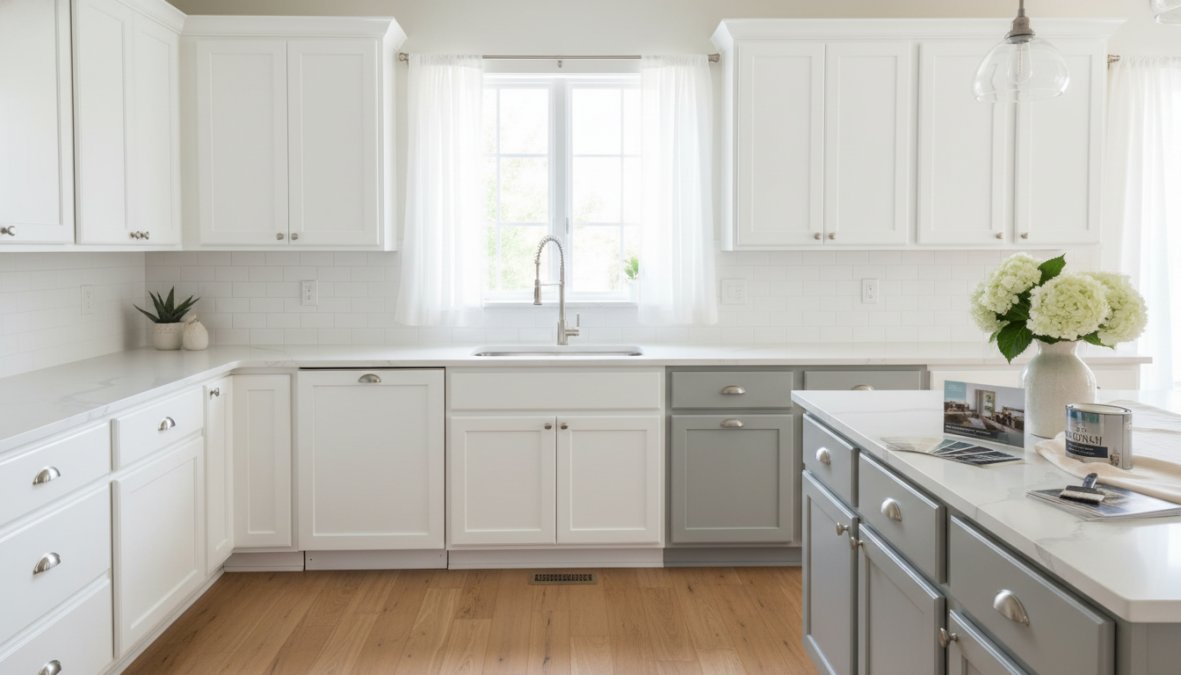
- They read as a backdrop, not a statement. White, soft gray, and greige allow countertops, backsplash, and hardware to carry the visual interest. Buyers see a kitchen that feels complete and flexible rather than one that demands a specific style commitment.
- They photograph well across lighting conditions. Online listings are the first showing for most buyers. Neutral cabinets reflect light evenly and render accurately on screens, while saturated colors can shift dramatically between natural light, artificial light, and camera white balance, often looking worse in photos than in person.
- They signal maintenance and care without demanding attention. A crisp white or warm gray cabinet reads as “recently updated” to buyers even when the underlying box is years old. The psychological association between neutral, clean finishes and a well-maintained home is consistent across buyer demographics.
The Most Reliably Strong Performers for Resale
- Crisp white or warm white: The most universally appealing choice. Warm whites (with yellow or red undertones) perform better than stark cool whites in kitchens with limited natural light, they feel inviting rather than clinical. Pairs with virtually any countertop or backsplash material.
- Soft gray: Reads as modern without being trendy. Appeals to buyers across age groups and pairs well with both warm and cool countertop tones. Avoids the “too cold” risk of blue-toned whites.
- Greige tones: Warm enough to feel inviting, neutral enough to suit varied tastes. Particularly effective in homes with warm wood flooring or warm-toned countertops, where a cool gray can feel disconnected.
- Navy or deep blue lower cabinets with white uppers: A two-tone approach that adds visual interest while keeping the overall palette controlled. Works best in kitchens with strong natural light and lighter countertops. Photographs well and reads as intentional design rather than a personal quirk.
How Color Interacts with Hardware, Lighting, and Backsplash
This is the integration angle most color guides ignore entirely. Cabinet color does not exist in isolation, it interacts with every other surface in the kitchen, and the combination is what buyers actually evaluate.
Cabinet color + hardware finish:
Warm whites and greiges pair most naturally with brushed gold, unlacquered brass, or warm brushed nickel hardware. Cool grays and whites pair with matte black or cool brushed nickel. Mismatching undertones, a warm white cabinet with cool chrome hardware, creates a subtle visual dissonance that buyers may not be able to name but will feel. Replacing hardware at the same time as painting is the single most cost-effective way to ensure the combination reads as intentional.
Cabinet color + lighting:
Under-cabinet lighting dramatically changes how cabinet color reads in person and in photographs. Warm-spectrum LED strips (2700K-3000K) make warm whites and greiges glow; cool-spectrum lighting (4000K+) flattens them. If the kitchen has dated or dim overhead lighting, updating the fixture alongside cabinet painting ensures the color performs as intended during showings and photography sessions.
Cabinet color + backsplash:
White cabinets give maximum flexibility, they work with subway tile, mosaic, stone, and painted backsplashes. Gray and greige cabinets require more attention to backsplash undertone: a cool gray backsplash against a warm greige cabinet can create a muddy, unresolved look. When backsplash replacement isn’t in the budget, choose a cabinet color that complements the existing backsplash rather than fighting it.
Before finalizing a cabinet color, pull a large sample chip and hold it against your existing countertop, backsplash, and flooring in both natural and artificial light. What looks right on a paint deck under store lighting can read very differently in your specific kitchen. Most professional painters will apply a test patch on an inconspicuous cabinet face before committing to the full job.
Colors to Avoid When Selling Your Home
Avoid highly personal color choices regardless of how current they feel in design media. Terracotta, deep forest green, and bright yellow have all had their moment. Buyers who don’t share your taste see these as immediate renovation projects, which translates directly into lower offers or longer time on market.
Also avoid stark, cool whites with strong blue undertones in kitchens with limited natural light, they photograph as gray and feel clinical in person. A warm white or cream performs better in these conditions.
Two-tone combinations that use two saturated colors (rather than one neutral and one accent) are high-risk for resale. The goal is a palette that the widest possible range of buyers can see themselves living with, not a kitchen that showcases your design sensibility.
Trendy colors that are prominent in design publications right now will look dated in 18 to 24 months. For resale, the question is never “what’s fashionable?”, it’s “what will the broadest range of buyers find inoffensive and appealing?” Those are different questions with different answers.
The Photography Test: Does Your Color Choice Work Online?
Because most buyers begin their search online, cabinet color needs to perform in listing photography, not just in person. Before finalizing a color, ask your painter or real estate agent to evaluate how it will photograph under your kitchen’s specific lighting conditions. Colors that look warm and inviting in person can render flat or washed out under certain flash or ambient light combinations. A professional real estate photographer can often advise on this before the paint job is complete, and their input is worth seeking before you commit to a color at scale.
Structural Assessment: Is Your Cabinet a Good Candidate for Painting?
Cabinet painting delivers excellent results on structurally sound boxes with solid wood or MDF door faces. It delivers poor results on cabinets with water damage, delaminating surfaces, compromised joints, or substrate issues that paint cannot fix. Skipping this assessment is the most common and most costly mistake sellers make.

Before committing to a paint job, evaluate your cabinets honestly. Paint is a finish, not a repair. Any structural problem that exists before painting will either show through the finish or worsen over time.
Cabinet Condition Checklist Before You Paint
Use this checklist to determine whether your cabinets are good candidates for painting:
- Cabinet boxes are square and doors hang level without adjustment
- No soft spots, swelling, or delamination on door faces or cabinet sides
- No visible water stains or damage around the sink base cabinet
- Drawer boxes open and close smoothly without catching
- Door hinges are functional and hold doors flush
- No peeling veneer or exposed particleboard edges on door faces
- Cabinet interiors are clean and free of mold or mildew
- Existing finish (paint or stain) is adhered well, with no widespread peeling
If you check all boxes, your cabinets are strong candidates. If you find water damage, delamination, or structural issues, address those first. Painting over problems doesn’t solve them; it creates disclosure complications and buyer trust issues.
Painting over water-damaged cabinet bases near the sink is a serious risk. If a buyer’s inspector identifies fresh paint over compromised wood, it can trigger concerns about concealment, which can derail a sale entirely. Repair first, paint second.
Kitchen Cabinet Painting Preparation Steps That Determine the Finish
The quality of a cabinet paint job is determined almost entirely by preparation, not by the paint itself. This is the insight that separates professional results from DIY disappointments. A premium paint applied over poor preparation will fail. A standard paint applied over meticulous preparation will last.
The kitchen cabinet painting preparation steps that matter most are:
- Remove all cabinet doors and hardware. Painting in place produces uneven results. Doors painted flat on a workbench dry without drips and allow full coverage of edges.
- Degrease all surfaces thoroughly. Kitchen cabinets accumulate grease and cooking residue that prevents paint adhesion. A dedicated degreaser is non-negotiable.
- Sand all surfaces to create mechanical adhesion. Light scuff sanding breaks the existing finish and gives the primer something to grip. Skip this step and the paint will peel.
- Apply a bonding primer. Primer application is the most skipped step in DIY cabinet painting and the most important one. Primer seals the substrate, blocks tannin bleed-through, and ensures the topcoat adheres uniformly.
- Sand between primer and topcoat. A light sand after the primer coat levels any raised grain and creates an ultra-smooth base for the finish coat.
- Apply topcoat in thin, even passes. Multiple thin coats outperform single thick coats every time. Thick coats sag, take longer to cure, and show brush marks.
- Allow full cure time before reinstalling. Paint may feel dry to the touch within hours but requires days to fully cure. Reinstalling doors too early causes the finish to stick to itself and peel.
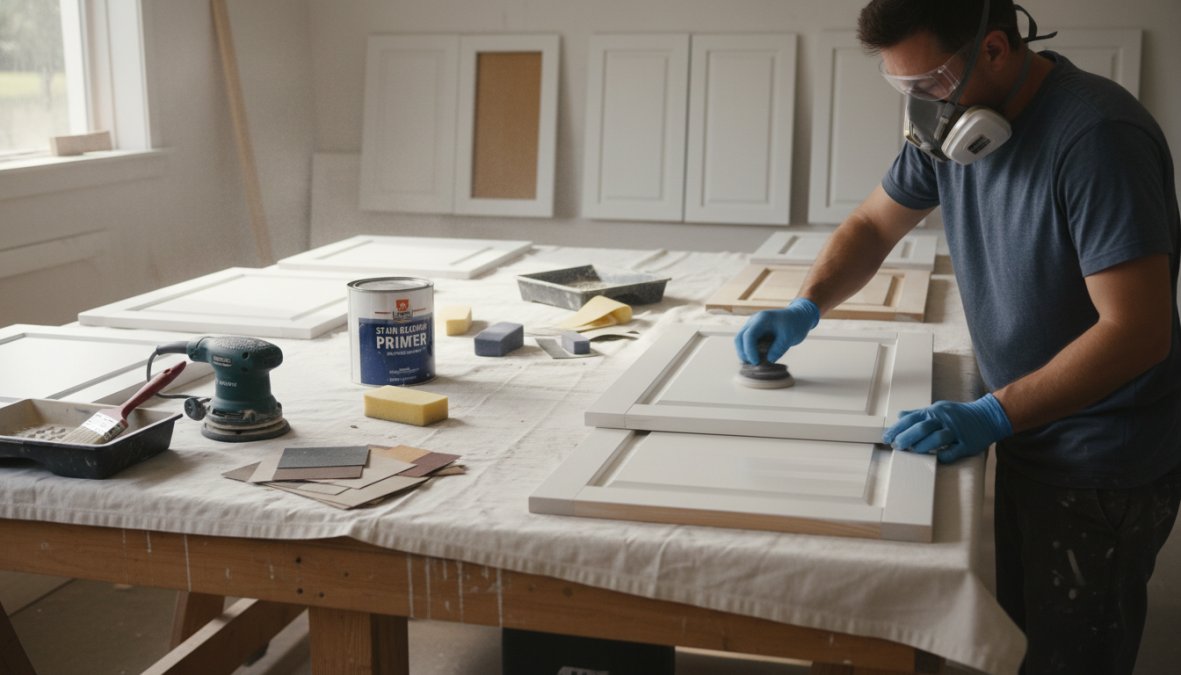
Surface preparation accounts for the majority of a cabinet paint job’s longevity and appearance. Any professional worth hiring will spend more time preparing surfaces than actually applying paint.
Cost to Paint Kitchen Cabinets Professionally vs. DIY
Professional cabinet painting costs more upfront than DIY but typically delivers better results and a faster timeline, both of which matter when you’re preparing a home for sale. The cost difference is real, but so is the quality gap.
| Approach | Typical Cost Range | Timeline | Finish Quality | Resale Impact |
|---|---|---|---|---|
| Professional painting | Higher investment | 3-5 days | Smooth, consistent | Strong positive |
| DIY with proper prep | Lower cost | 5-10 days | Variable | Moderate positive |
| DIY without proper prep | Lowest cost | 2-3 days | Poor | Neutral to negative |
For sellers, the professional vs. DIY decision comes down to one question: can you achieve a finish that looks professional? Buyers and their agents have seen enough homes to recognize an amateur paint job. A subpar DIY finish can actually hurt your negotiating position by signaling that other work in the home may have been done at the same quality level.
Denver Cabinet Painting Colorado, with 40 years of experience serving Colorado homeowners, specializes in exactly this scenario. Their process emphasizes meticulous preparation and professional application, producing smooth, consistent finishes that hold up to the scrutiny of buyers, agents, and inspectors.
Choosing the Right Paint Finish for Durability and Resale Appeal
Paint finish selection affects both durability and how the kitchen photographs. For cabinet doors and drawer faces, semi-gloss finish and high-gloss paint are the standard professional choices. Both are cleanable, durable, and reflect light in ways that make a kitchen feel brighter and more modern.
Matte and eggshell finishes have no place on kitchen cabinets intended for resale. They absorb grease, show fingerprints visibly, and are difficult to clean without dulling the finish. Prospective buyers who notice grimy-looking matte cabinets during a showing will not be impressed.
Semi-gloss is the most practical choice: durable enough for daily use, reflective enough to photograph well, and forgiving enough that minor surface variations don’t telegraph through the finish the way high-gloss can.
Paint durability matters because buyers may move in months after the sale. A finish that chips or peels within a year reflects poorly on the seller’s choices and can generate post-sale friction.
How Long Does It Take to Paint Kitchen Cabinets Before Listing?
A professional cabinet painting project on a standard kitchen takes three to five days from start to reinstallation. This includes time for degreasing, sanding, primer application, topcoat application, and cure time before doors are rehung.
DIY projects on the same kitchen typically take longer, often extending to a week or more when proper preparation steps are followed. Rushing the process, particularly by skipping cure time, is the most common way DIY projects produce disappointing results.
For sellers working against a listing deadline, the professional timeline is a genuine advantage. The kitchen is out of commission for a shorter period, and the result is ready for professional photography within days of completion.
According to Houzz Kitchen Trends Study on renovation timelines and buyer appeal, kitchen updates that are completed and photographed well significantly increase online listing engagement, which is the first battleground in today’s home sale process.
Integrating Cabinet Painting with Other Pre-Sale Kitchen Upgrades
Cabinet painting delivers its strongest resale impact when it’s part of a coordinated kitchen refresh rather than an isolated upgrade. The kitchen reads as a system to buyers: cabinets, hardware, countertops, backsplash, and appliances all contribute to the overall impression.
The most cost-effective integration strategy pairs cabinet painting with:
- New cabinet hardware: Replacing dated brass or worn chrome hardware with brushed nickel or matte black costs relatively little and dramatically modernizes the look
- Updated lighting: Under-cabinet lighting and a new fixture above the island or peninsula improve both the appearance and the photography
- Countertop assessment: If countertops are dated but functional, cleaning and resealing them alongside fresh cabinet paint creates a cohesive look without countertop replacement costs
- Backsplash refresh: A simple subway tile backsplash or a painted backsplash can complete the kitchen transformation at modest cost
The goal is coherence. A kitchen where the cabinets are freshly painted but the hardware is visibly dated or the lighting is dim reads as a half-finished project. Buyers notice the gaps.
Painting Kitchen Cabinets for Resale Value: Final Verdict
Painting kitchen cabinets for resale value is one of the most defensible pre-sale investments available, with a clear caveat: the cabinets must be structurally sound, the preparation must be thorough, and the color selection must prioritize broad buyer appeal over personal preference.
The homes that see the strongest return from cabinet painting are those where the existing cabinets are solid but dated, the color is outdated or highly personal, and the surrounding kitchen finishes are in reasonable condition. In those scenarios, a professional cabinet paint job transforms the kitchen from a buyer objection into a selling point.
The homes where cabinet painting backfires are those where paint is used to conceal structural problems, where preparation is skipped in the interest of speed, or where bold color choices narrow the buyer pool. Avoid those scenarios and the investment is almost always justified.
For sellers in the Denver metro area and across Colorado, the competitive real estate market makes kitchen presentation more important than ever. Prospective buyers have options, and a dated kitchen is one of the fastest ways to lose use in negotiations.
Preparing a kitchen for sale requires balancing cost, timeline, and impact, and most homeowners find that navigating those trade-offs alone leads to suboptimal results. Denver Cabinet Painting Colorado brings 40 years of experience to exactly this challenge, specializing in cabinet painting, refinishing, and glazing services that produce smooth, consistent finishes built to withstand buyer scrutiny. Their team handles the meticulous preparation that determines whether a finish lasts. Get a free quote from Denver Cabinet Painting Colorado and list your home with a kitchen that commands the price it deserves.
Frequently Asked Questions
Does painting kitchen cabinets increase home value?
Painting kitchen cabinets for resale value can meaningfully improve your home’s marketability and first impressions without the cost of a full kitchen remodel. Fresh, neutral-colored cabinets make a kitchen feel modern and well-maintained, which can positively influence both buyer interest and home appraisal outcomes. However, the actual dollar increase depends on your local market, the quality of the paint job, and the overall condition of the kitchen. Professional results tend to yield stronger returns than rushed DIY work.
What are the best cabinet paint colors for resale value?
Neutral colors consistently perform best for resale. Shades like white, off-white, soft gray, and greige appeal to the widest range of prospective buyers and create a timeless look that photographs well for listings. These colors also make kitchens feel larger and brighter. Avoid bold or trendy colors like navy, black, or deep green unless your market strongly supports them, what feels stylish today can feel dated to buyers within a few years.
Cabinet Painting Service Areas in Denver & Surrounding Cities, Cabinet Refinishing in Denver County,
Serving Lakewood, CO, Littleton, CO, Golden, CO, Evergreen CO, Roxborough Park CO, Ken Carl Ranch CO,
Arvada, CO, Wheat Ridge, CO,
and Parker CO. Castle Pines CO. Englewood CO. Centennial CO.
Cabinet Painting in Arapahoe County, CO
Including Centennial, CO, Greenwood Village, CO,
Cherry Hills Village, CO, Englewood, CO,
and Aurora, CO.
Cabinet Painting in Adams County & Broomfield, CO
Should I paint my cabinets or replace them before selling?
For most homeowners, cabinet painting is the more cost-effective pre-sale upgrade compared to full cabinet replacement. Replacement can cost several times more and rarely delivers proportional resale returns. Painting makes sense when cabinet boxes are structurally sound, no water damage, warping, or failing joints. If cabinets are severely damaged or falling apart, replacement may be necessary. A structural assessment checklist should be your first step before committing to either option.
How much does it cost to paint kitchen cabinets professionally?
The cost to paint kitchen cabinets professionally varies by kitchen size, cabinet count, condition, and region. In markets like Denver, Colorado, professional cabinet painting generally ranges from a few hundred to several thousand dollars depending on scope. This typically includes surface preparation, primer application, and multiple finish coats. While DIY painting costs less upfront, professional results, especially with proper prep and a semi-gloss or high-gloss finish, tend to hold up better and impress buyers more effectively.
How long does it take to paint kitchen cabinets before listing a home?
A professional cabinet painting project typically takes two to five days from start to finish, depending on kitchen size, the number of cabinet doors, and drying time between coats. DIY projects often take longer due to inexperience and equipment limitations. When selling, it is wise to schedule cabinet painting at least one to two weeks before listing photos are taken, allowing time for any touch-ups and for paint to fully cure before the kitchen is staged and shown to prospective buyers.
What paint finish is best for kitchen cabinets when selling a home?
Semi-gloss finish is the most recommended option for kitchen cabinets going to market. It is durable, easy to clean, and reflects light in a way that makes the kitchen feel fresh and well-maintained, qualities that appeal to prospective buyers. High-gloss paint is another strong option for a more modern kitchen look but can highlight surface imperfections if preparation is not thorough. Flat or matte finishes are generally not recommended for cabinets due to lower paint durability and difficulty cleaning.
This article was written using GrandRanker