
Table of Contents
- Cost of Professional Kitchen Cabinet Painting: National Average and Price Range
- Factors Affecting Cabinet Painting Quotes
- Cabinet Painting Process Steps and Labor Timeline
- How Long Does Professional Cabinet Painting Take
- Kitchen Cabinet Painting vs. Replacement Cost: Which Makes Sense
- DIY vs. Professional Cabinet Painting: Cost and Quality Comparison
- How to Save Money on Cabinet Refinishing Without Sacrificing Quality
- Getting an Accurate Cost Estimate for Your Kitchen Cabinet Project
Cost of Professional Kitchen Cabinet Painting: 2026 Guide
Last Updated: July 4, 2026
Understanding the cost of professional kitchen cabinet painting requires looking beyond simple price quotes. Pricing varies dramatically based on project scope, finish quality, and surface preparation complexity. Below, we’ll show you exactly how to evaluate quotes, understand what you’re paying for, and avoid hidden expenses that catch most homeowners off guard.
Cost of Professional Kitchen Cabinet Painting: National Average and Price Range
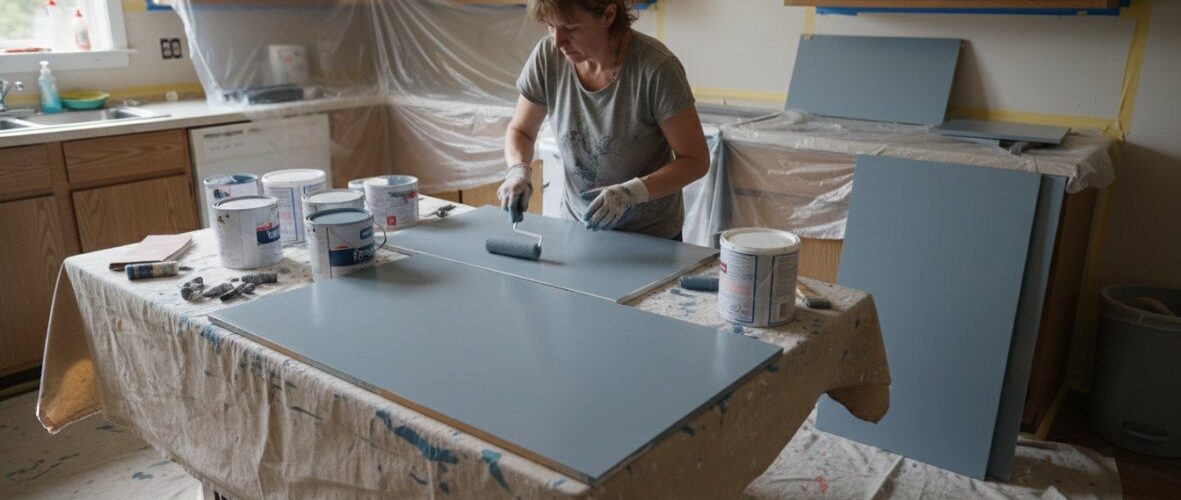
Most homeowners invest between $1,500 and $5,000 for a complete professional kitchen cabinet painting project. A typical small kitchen with 15-20 cabinet doors and drawer fronts runs $1,500 to $2,500. Medium kitchens with 25-35 cabinet pieces average $2,500 to $4,000. Large kitchens exceeding 40 cabinet components often exceed $5,000, particularly with custom finishes or premium paints. Professional Cabinet Painting
The cost breaks down into three primary components: labor (60-70% of total cost), materials including primer and topcoat finishes (20-25%), and surface preparation work like sanding, degreasing, and caulking (10-15%).
The single biggest variable in cabinet painting costs is surface preparation quality. Thorough preparation adds 3-5 days to project timelines but dramatically improves finish durability and appearance.
Professional painters typically charge between $75 and $150 per cabinet door or drawer front, depending on complexity and finish type.
Typical Cost Breakdown by Project Size
| Project Size | Cabinet Count | Typical Cost Range | Cost Per Piece | Timeline |
|---|---|---|---|---|
| Small | 15-20 | $1,500-$2,500 | $100-$150 | 5-7 days |
| Medium | 25-35 | $2,500-$4,000 | $85-$120 | 8-12 days |
| Large | 40+ | $4,000-$6,500+ | $75-$110 | 12-18 days |
Small kitchen projects include basic surface preparation, primer application, and standard topcoat finish. Materials cost $200-400, with labor comprising the remainder.
Medium kitchen projects allow painters to establish efficient workflows and justify investment in specialized equipment like HVLP sprayers that improve finish quality. Material costs rise to $400-700. Per-unit costs decrease due to efficiency gains.
Large kitchen projects justify investment in advanced spray equipment and meticulous curing time between coats. Material costs climb to $800-1,500 as painters apply additional topcoats and specialty primers. These projects often include hardware replacement and cabinet box refinishing beyond doors and drawer fronts.
Factors Affecting Cabinet Painting Quotes
Several concrete factors determine why similar kitchens receive vastly different quotes.
Cabinet Size and Square Footage
Cabinet painting costs scale with total paintable surface area. Painters measure not just doors and drawers but also cabinet box sides, frame rails, and exposed interior surfaces. A kitchen with 30 cabinet doors might have 150-200 square feet of total paintable surface.
A 10×12 foot kitchen with standard 36-inch-tall cabinets presents roughly 120-150 square feet of paintable surface. Kitchens with 42-inch cabinets add 25-40% more surface area.
Island installations expose multiple sides of cabinet boxes that wall-mounted cabinets conceal. A four-sided island adds 30-50% to painting costs compared to similar wall cabinets.
Finish Quality: Factory-Grade vs. Budget Options
Budget finishes using basic latex paint and single topcoat applications cost $500-1,000 in materials for a medium kitchen. These show wear within 3-5 years in busy kitchens.
Professional-grade enamel finishes with primer and two topcoats cost $1,000-1,500 in materials. These resist moisture, heat, and daily wear significantly better than budget options.
Factory-grade lacquer finishes represent the premium tier, costing $1,500-2,500 in materials alone. Lacquer provides the smoothest, most durable finish available outside of full cabinet replacement and resists yellowing better over time.
Budget finishes using single topcoats often fail within 2-3 years in kitchens with high moisture exposure. The cost savings of $300-500 typically results in needing repainting within a decade, making premium finishes more economical long-term.
Spray application costs 15-25% more than brush application but delivers superior smoothness and even coverage.
Cabinet Painting Process Steps and Labor Timeline
Professional cabinet painting follows a standardized process that separates quality work from rushed jobs.
Degreasing, Sanding, and Caulking
Surface preparation consumes 40-50% of total project labor but determines finish quality and durability. The process begins with thorough degreasing using specialized cleaners that remove kitchen grease, dust, and residue. This typically requires 1-2 days for a medium kitchen.
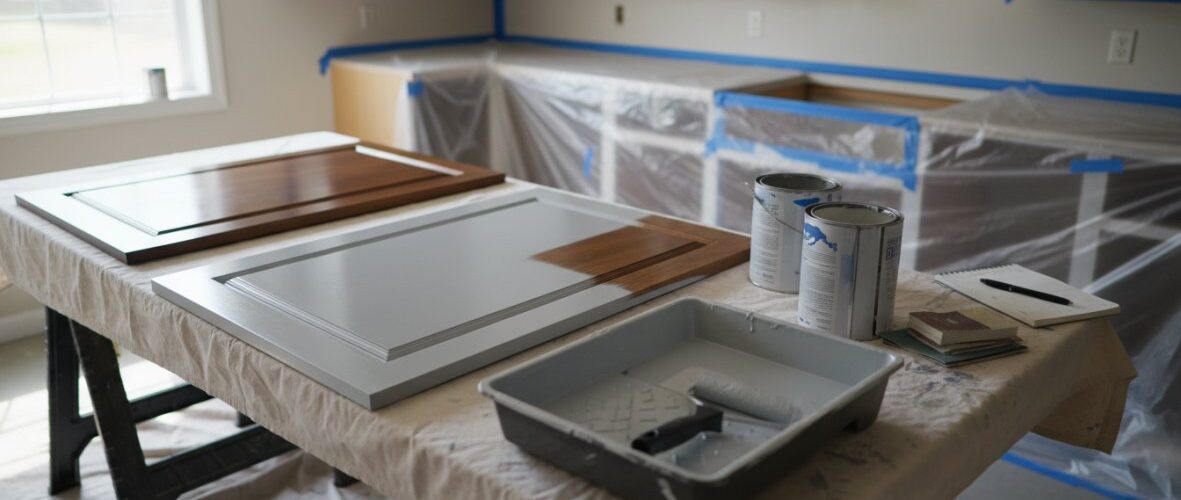
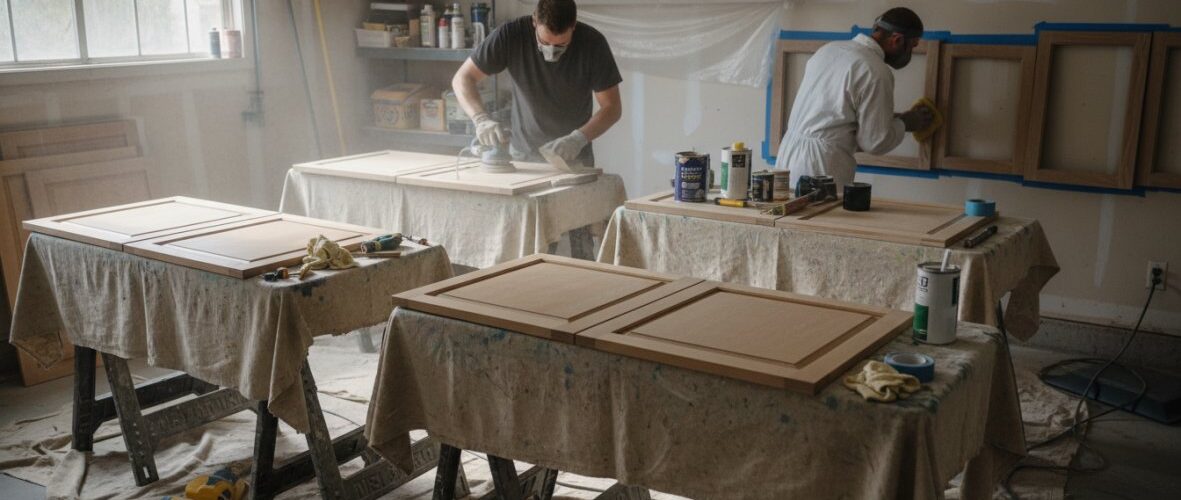
Sanding removes the existing finish’s gloss, creates micro-texture for paint adhesion, and reveals damage requiring filler. A medium kitchen typically requires 3-5 days of sanding work using orbital sanders for flat surfaces and hand-sanding for edges and detailed areas.
Caulking fills gaps between cabinet frame rails, around hardware holes, and where cabinet components meet. Paintable caulk rated for kitchens resists moisture better than standard varieties. Caulking typically consumes 1-2 days for a complete kitchen.
Wood filler addresses gouges, dents, and damage revealed during sanding. Painters apply filler, sand smooth, and repeat until surfaces are perfectly flat.
Primer Application and Topcoat Finish
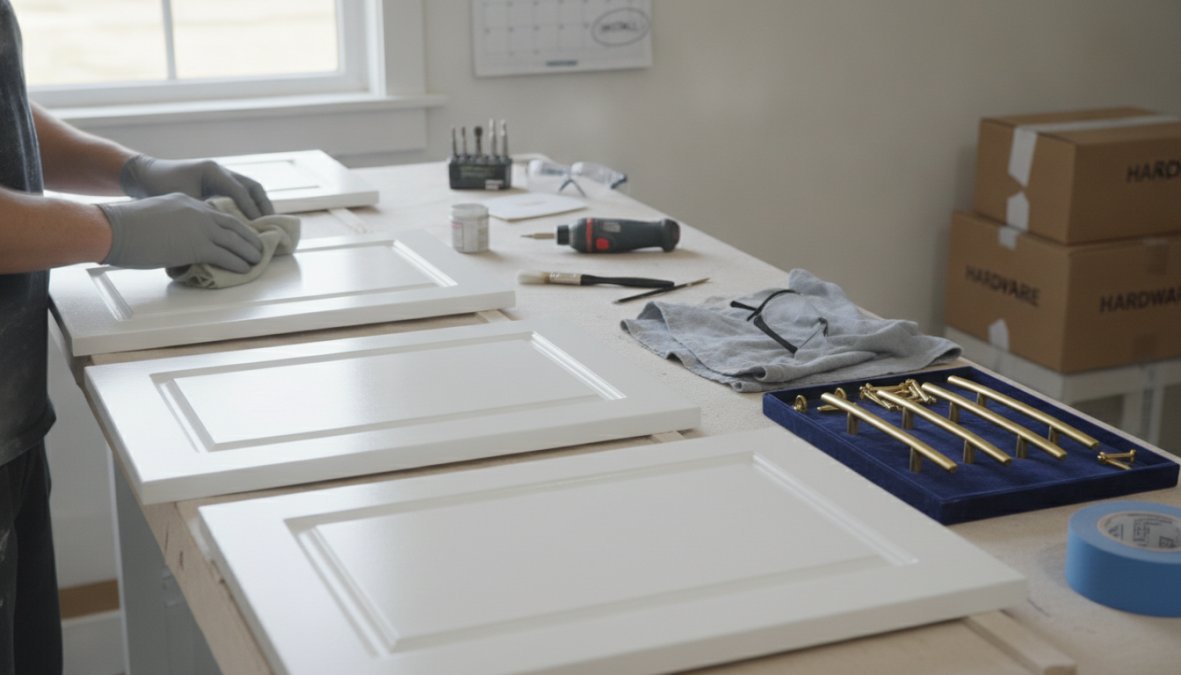
Primer application creates a uniform base that improves topcoat adhesion and finish consistency. Quality primers are essential for cabinets that have been stained or show water damage. Primers typically require 1-2 days for application and 24 hours curing time.
Topcoat application represents the visible finish. Professional painters apply at least two topcoats, with premium finishes receiving three or more. Each coat requires 24-48 hours curing time before the next application. Spray application delivers smoother results than brushing.
Single topcoats show wear within 12-24 months in busy kitchens. Dual topcoats typically last 5-7 years. Triple topcoats in lacquer finishes can last 10+ years with proper maintenance.
Curing Time and Project Completion
Cabinet painting projects require proper curing time for full hardness and durability. Most enamel finishes require 7-14 days full curing before resuming normal kitchen use. Lacquer finishes cure faster (3-5 days) due to solvent evaporation.
During curing, kitchens should remain closed off from heavy use. Steam from cooking and humidity spikes can compromise curing finishes.
Total project timeline from first day to full completion typically ranges 10-18 days for a medium kitchen, including 5-7 days active work plus 5-7 days curing time.
How Long Does Professional Cabinet Painting Take
A small kitchen typically requires 8-12 days from start to full completion, including 4-5 days of active work plus 4-7 days of curing time.

Medium kitchens average 12-16 days total timeline. Active work typically spans 6-8 days, with curing time consuming the remainder.
Large kitchens with complex finishes can extend 18-24 days or longer. Premium lacquer finishes require more meticulous surface preparation and longer curing between coats.
Request a detailed timeline showing each phase of work when getting quotes. Painters who promise completion in 5-7 days are likely skipping proper curing time or surface preparation. Quality work requires 10-14 days minimum for medium kitchens.
Kitchen Cabinet Painting vs. Replacement Cost: Which Makes Sense
Cabinet replacement costs $15,000-30,000 for a medium kitchen, making cabinet painting an attractive alternative at 1/5 to 1/10 the cost.
Long-Term ROI and Durability of Painted Cabinets
Professional cabinet painting delivers 5-7 years of acceptable appearance in busy kitchens, or 7-10 years in light-use kitchens. Refreshing painted cabinets costs only $2,000-3,500, making repainting every 7-10 years economically superior to replacement.
Initial painting at $3,000 plus repainting at year 7 ($2,500) equals $5,500 over 14 years. Cabinet replacement at $20,000 represents a much larger initial investment, though replacement cabinets typically last 20+ years.
Painted cabinets work best when the underlying cabinet structure is sound. If cabinets have water damage, warping, or structural issues, replacement becomes the better choice.
Professional vs. Handyman Quality: What You’re Actually Paying For
The difference between professional cabinet painters and handymen shows up primarily in surface preparation and finish smoothness. Professionals charge $3,000-4,000 for a medium kitchen while handymen charge $1,500-2,000. This 50-100% difference reflects several quality factors.
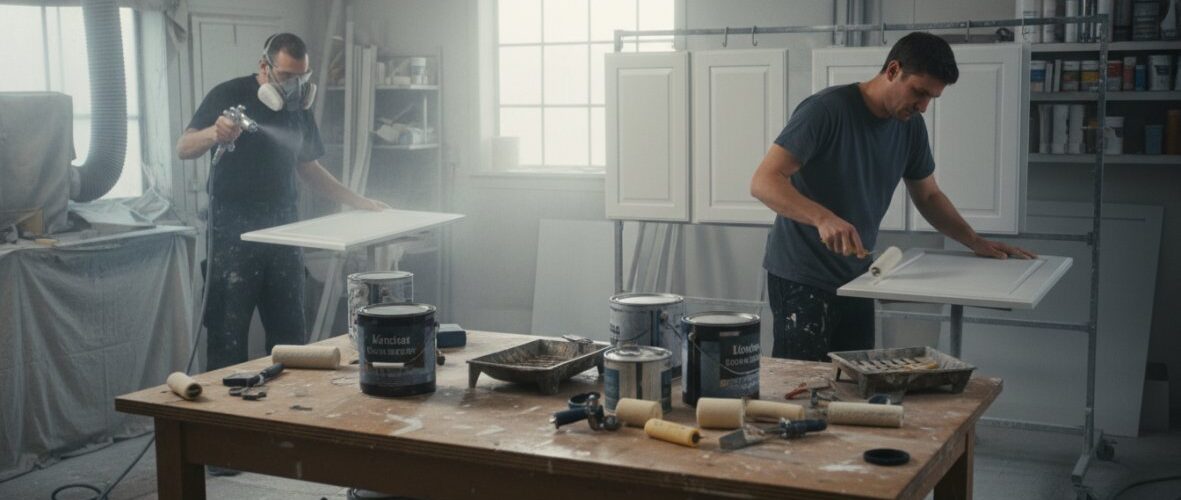
Professional painters invest in specialized equipment like HVLP sprayers ($2,000-5,000) that deliver superior smoothness compared to brush application. Professionals spend 5-7 days on preparation; handymen often allocate 1-2 days. This difference directly impacts finish longevity.
Professionals use premium primers rated for kitchen moisture exposure and topcoats formulated for high-traffic surfaces. Professional painters typically guarantee their work for 1-3 years against peeling, chipping, or adhesion failure. Handymen rarely offer warranties.
DIY vs. Professional Cabinet Painting: Cost and Quality Comparison
DIY cabinet painting costs $300-800 in materials but requires 40-80 hours of your time. This approach makes sense if you have painting experience and access to proper equipment.
DIY projects typically achieve acceptable results on cabinet doors and drawer fronts but struggle with cabinet boxes and detailed areas. Brush marks remain visible under lighting. Most DIY painters apply single topcoats due to time constraints, resulting in finishes that wear noticeably within 12-24 months.
Professional HVLP sprayers cost $2,000-5,000 new; renting them costs $50-100 per day. Purchasing quality sanders and safety equipment adds another $500-1,000.
Surface preparation alone consumes 20-30 hours. Adding primer application, topcoats, and cleanup typically extends projects to 60-80 hours spread across 3-4 weeks.
Professional painting costs 3-5 times more than DIY materials but delivers results lasting 2-3 times longer. The cost-per-year calculation often favors professional work.
How to Save Money on Cabinet Refinishing Without Sacrificing Quality
Strategic choices during planning can reduce professional painting costs by 20-30% without compromising quality.
Selecting a standard finish color costs less than custom color matching. Neutral tones like white, gray, or natural wood finishes require less material and allow efficient work.
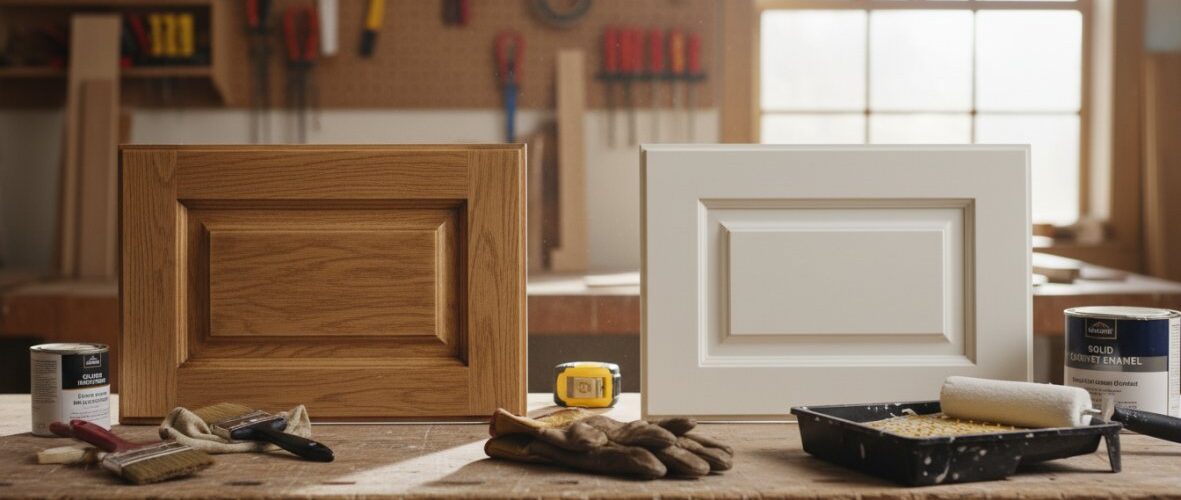
Choosing enamel finishes over lacquer reduces material costs by $500-800 while still delivering excellent durability. Enamel finishes last 5-7 years in busy kitchens.
Scheduling projects during slower seasons (November-February) often qualifies you for 10-15% discounts. Professional painters have more availability during winter months.
Limiting project scope reduces costs proportionally. Painting only cabinet doors and drawer fronts (not cabinet boxes) costs 30-40% less than full refinishing.
Accepting longer project timelines sometimes reduces costs. If a painter can schedule your project over two weeks rather than one, they might offer a 10-15% discount.
Contractor Vetting Checklist and Red Flags
Verify licensing and insurance before hiring any contractor. Professional painters carry liability insurance and workers’ compensation coverage. Request proof of both before signing contracts.
Request references from recent projects and contact them. Ask specifically about surface preparation quality, finish durability, and timeline adherence. References from projects completed 1-2 years ago show how finishes have held up.
Examine portfolio photos carefully. Look for smooth, even finishes without visible brush marks or drips. Photos showing cabinet interiors and detailed areas indicate attention to quality.
Red flags include quotes significantly below market rates, reluctance to provide references, and pressure to pay upfront before work begins. Professional painters request partial payment upon contract signing and completion milestones.
Confirm the painter’s understanding of surface preparation. Ask specifically about their degreasing process, sanding approach, and caulking methods. Vague answers suggest they’re minimizing this critical phase.
Verify warranty coverage in writing. Professional painters guarantee their work for 1-3 years against adhesion failure, peeling, or chipping.
Getting an Accurate Cost Estimate for Your Kitchen Cabinet Project
Obtaining accurate quotes requires providing contractors with detailed project information.
Photograph your kitchen from multiple angles, including close-ups of cabinet doors and any damage or finish condition. These photos help contractors understand surface preparation requirements.
Document your cabinet count precisely. Count all cabinet doors, drawer fronts, and cabinet box sides you want painted. Include islands and peninsulas.
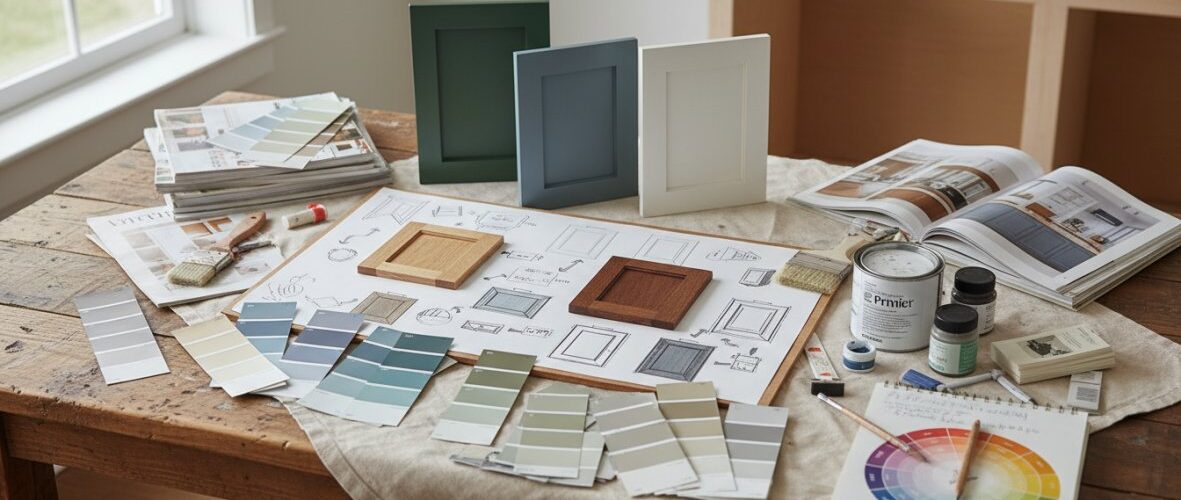
Specify your finish preference clearly. Provide paint color samples or references. Describe your preferred finish type: enamel for durability, or lacquer for maximum smoothness. Mention whether you want matte, satin, or semi-gloss sheen.
Request itemized quotes breaking costs into labor, materials, and surface preparation. Labor should represent 60-70% of the total; if significantly less, surface preparation is likely insufficient.
Ask contractors to specify curing time and project timeline in writing. Professional quotes should allocate 10-16 days for medium kitchens, including curing time.
Request warranty information in writing. Professional painters should guarantee their work for 1-3 years against peeling, chipping, or adhesion failure.
According to the National Association of Home Builders, kitchen renovations including cabinet refinishing rank among homeowners’ top priorities for increasing property value. Cabinet painting specifically offers one of the best returns on investment for kitchen updates, typically recovering 50-70% of costs in resale value.
Research from the Kitchen Cabinet Manufacturers Association indicates that professionally painted cabinets maintain color consistency and finish integrity significantly better than DIY approaches, with proper preparation being the primary differentiator.
The cost of professional kitchen cabinet painting represents an investment in kitchen functionality and aesthetics. Understanding what drives costs, surface preparation quality, finish type, labor expertise, and project complexity, helps you evaluate quotes and make decisions aligned with your budget and renovation goals. Professional painters deliver results lasting years longer than budget alternatives, making the higher initial investment economically sound when calculated over the long term.
Frequently Asked Questions
How much does it cost to have kitchen cabinets professionally painted?
The cost of professional kitchen cabinet painting typically ranges from $1,500 to $15,000+, depending on kitchen size, cabinet condition, and finish quality. A small kitchen might cost $1,500-$3,500, while a large kitchen with premium lacquer or enamel finishes can reach $10,000-$15,000. Labor costs generally represent 50-70% of the total project cost, with materials and surface preparation making up the remainder. Professional painters charge by the door, drawer, or square footage, so getting a detailed quote from local contractors is essential.
What factors affect the cost of professional cabinet painting?
Key factors affecting cabinet painting quotes include cabinet size and square footage, current condition requiring surface preparation (sanding, degreasing, caulking), finish type (budget enamel vs. factory-grade lacquer), hardware replacement needs, and project complexity. Soft-close hinge upgrades, wood filler for damaged areas, and spray finish application via HVAC sprayer add to costs. Your service area and local contractor fees also influence pricing. Detailed surface preparation, often the most time-intensive phase, significantly impacts labor costs and final quality.
Is it cheaper to paint cabinets or replace them?
Cabinet painting costs $1,500-$15,000, while full replacement typically costs $5,000-$40,000+. Painting is generally 50-75% cheaper and offers excellent long-term ROI if you maintain the finish. However, if cabinets are severely damaged, warped, or outdated in style beyond what paint can address, replacement may be worthwhile. Professional cabinet painting with proper surface preparation and premium finishes (lacquer or enamel) can last 7-10 years with minimal maintenance, making it a cost-effective kitchen renovation choice for most homeowners.
How long does professional kitchen cabinet painting take?
Professional cabinet painting typically takes 2-4 weeks from start to finish, including surface preparation (3-5 days), primer and topcoat application (5-7 days), and curing time (7-14 days). Labor hours depend on cabinet size, small kitchens may require 40-80 hours, while large kitchens can take 150+ hours. Most painters work in phases to minimize kitchen disruption. Curing time for lacquer or enamel finishes is critical; full hardness may take 2-3 weeks before normal cabinet use. Your contractor should provide a detailed timeline in the professional quote.
This article was written using GrandRanker