Table of Contents
- Is Cabinet Refinishing Worth the Money? The Core Case
- Cabinet Refinishing Cost: What to Expect and ROI Breakdown
- Cabinet Refacing vs. Refinishing: Which Is Worth More?
- Professional Cabinet Refinishing vs. DIY: Honest Pros and Cons
- How Long Does Cabinet Refinishing Take and Last?
- Environmental Benefits, Chemical Safety, and VOCs
- Cabinet Material Compatibility and Color Selection
- Is Cabinet Refinishing Worth the Money? Final Verdict
Last Updated: May 21, 2026
Deciding whether is cabinet refinishing worth the money comes down to one question: can you get a near-new kitchen without paying near-new prices? The answer, for most homeowners, is yes. At Denver Cabinet Painting Colorado, we’ve spent 40 years helping Colorado homeowners and commercial clients transform outdated cabinetry into spaces they’re proud of, and the value case for professional refinishing has never been stronger. Below, we’ll walk through the real costs, the ROI math, the honest trade-offs versus DIY, and the angles most guides skip entirely: material compatibility, chemical safety, and how long a quality finish actually lasts.
Here’s what most guides get wrong: they treat cabinet refinishing as a budget compromise. It isn’t. Done correctly, with proper surface preparation and professional-grade spray equipment, a refinished cabinet can hold a factory-like finish for a decade or more. That changes the math considerably.
Is Cabinet Refinishing Worth the Money? The Core Case
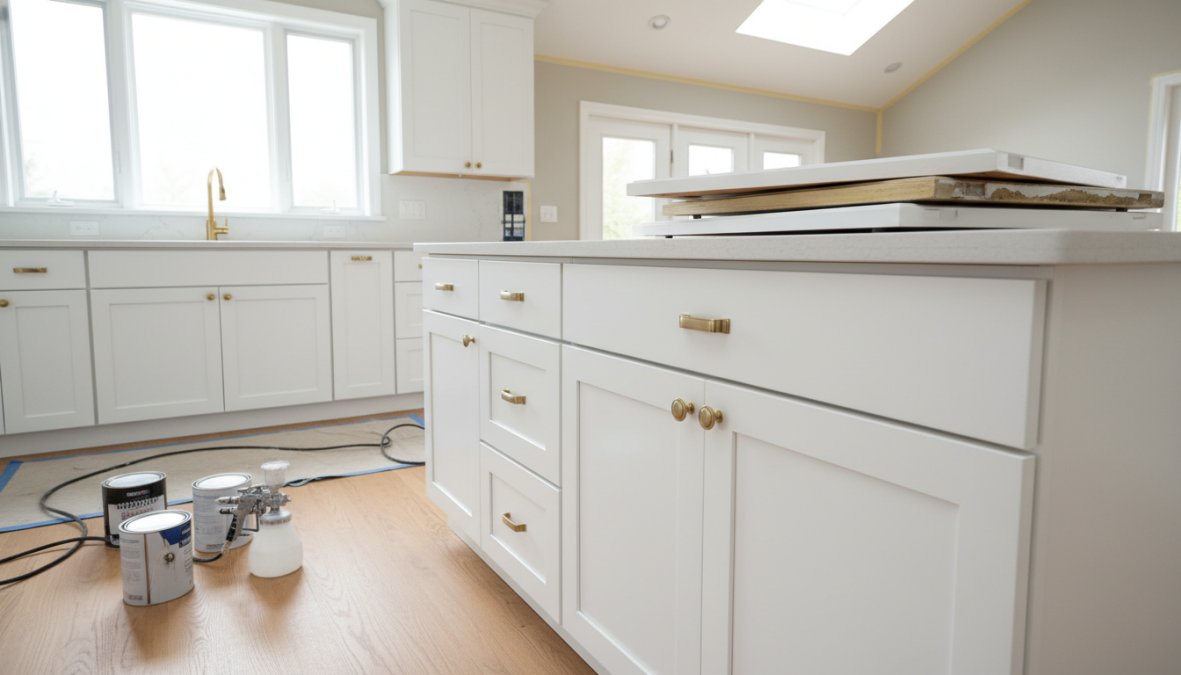
Cabinet refinishing is the process of stripping, sanding, priming, and recoating existing cabinet boxes and doors to restore or completely change their appearance without replacing the underlying structure. It is one of the highest-return kitchen updates available to homeowners.
The core value proposition is straightforward. Your cabinet boxes are almost always structurally sound even when the finish looks dated, discolored, or worn. Refinishing addresses the surface while preserving the underlying investment. According to the National Association of Realtors’ Remodeling Impact Report, kitchen updates consistently rank among the top projects for both homeowner satisfaction and resale return.
Cost-Effectiveness vs. Full Kitchen Renovation
Full cabinet replacement is one of the most expensive line items in any kitchen renovation. New cabinetry, installation labor, and disposal of old units combine into a cost that most homeowners underestimate before getting quotes. Refinishing sidesteps all three.
A professional refinishing job addresses the same visual problem at a fraction of the cost. You keep the existing layout, the existing hardware locations, and the existing cabinet boxes. The only thing that changes is the finish, and that finish is the only thing most visitors to your kitchen actually see.
The contrarian point worth making: many homeowners who start researching full cabinet replacement end up choosing refinishing not because they can’t afford replacement, but because they realize replacement doesn’t actually solve their problem. The problem is almost always aesthetic, not structural.
Increased Home Resale Value
Cabinet refinishing adds measurable resale value because kitchens are the room buyers scrutinize most. Fresh, consistent cabinetry signals a well-maintained home. Dated, worn cabinetry signals deferred maintenance, even when everything else is in good shape.
The resale math works in your favor because the cost of refinishing is typically recovered in the sale price. Real estate professionals consistently note that kitchen presentation influences buyer perception more than nearly any other interior factor. A smooth, modern finish on existing cabinetry can shift buyer perception from "needs work" to "move-in ready," a distinction worth thousands in negotiating use.
Cabinet refinishing addresses the single most buyer-scrutinized room in the home at a cost that is typically recovered in full at resale. The return is strongest when the cabinetry layout and construction are already solid.
Cabinet Refinishing Cost: What to Expect and ROI Breakdown
Most guides on this topic either invent dollar figures or refuse to publish any at all. This section does neither. Instead, it gives you the real cost framework, the variables that move the number in your specific kitchen, and the ROI logic that lets you evaluate the investment on its own terms, not just relative to the scarier number of full replacement.
What Professional Cabinet Refinishing Actually Costs
Professional cabinet refinishing in most U.S. markets is priced per door and drawer front, with the cabinet boxes included in the overall scope. Industry practitioners consistently report that a standard kitchen, typically 30 to 50 door and drawer fronts, falls in a range that represents roughly 15 to 25 percent of what full custom cabinet replacement would cost for the same kitchen. Semi-custom replacement runs higher still.
The variables that move your specific number:
- Cabinet count and linear footage, The single largest cost driver. More doors and drawer fronts mean more prep time, more material, and more spray passes. A galley kitchen with 20 doors costs meaningfully less than an open-plan kitchen with 50.
- Existing finish condition, Cabinets with heavy grease buildup, prior paint layers, or surface damage require additional degreasing cycles, sanding passes, and priming coats before a topcoat can be applied correctly. This adds labor hours.
- Topcoat specification, This is where the quality gap lives. A standard latex paint topcoat costs less upfront but typically lasts three to five years in a working kitchen before showing wear. A catalyzed conversion varnish or two-component polyurethane costs more in materials and requires professional spray equipment to apply correctly, but delivers a finish that most practitioners rate at eight to twelve years of normal kitchen use. The cost-per-year math strongly favors the premium topcoat.
- Color complexity, Single-color jobs in stock colors are the most efficient. Custom color matching, two-tone designs (island versus perimeter), or glazed finishes require additional setup, quality control passes, and sometimes longer dry times between coats.
- Hardware replacement, Not strictly part of refinishing, but almost always recommended alongside it. New hardware is a relatively small line item with a disproportionate visual impact on the finished result.
- Site conditions and access, Projects requiring on-site spray (rather than shop finishing of removed doors) involve more masking, containment, and ventilation setup, which adds to labor cost.
The ROI Framework: How to Evaluate the Investment
The return on cabinet refinishing operates through two channels: resale value recovery and cost-per-year of enjoyment. Most homeowners focus only on the first and undervalue the second.
Resale value recovery: Real estate professionals consistently identify the kitchen as the room that most influences buyer perception and offer price. Cabinetry is the dominant visual element in most kitchens. Dated or worn cabinetry signals deferred maintenance to buyers, even when the underlying structure is sound, and that perception translates directly into lower offers or requests for concessions. A professionally refinished kitchen shifts buyer perception from "needs work" to "move-in ready," a distinction that practitioners in competitive markets describe as worth several times the cost of the refinishing project in negotiating position alone.
According to the National Association of Realtors’ Remodeling Impact Report, kitchen projects consistently rank among the highest for both cost recovery and homeowner satisfaction scores. While the NAR data covers full kitchen remodels rather than refinishing specifically, the underlying mechanism, buyer perception of kitchen condition driving offer behavior, applies directly to cabinetry presentation.
Cost-per-year of enjoyment: This is the calculation most guides skip entirely. If a professional refinishing project using a quality catalyzed topcoat delivers ten years of finish life, the annual cost of that investment is a fraction of what most homeowners spend on other recurring home maintenance items. Compared against the cost of full replacement amortized over the same period, refinishing typically delivers a lower annual cost for a comparable visual result, with the added benefit of zero disruption to kitchen layout or function during the project.
| Evaluation Factor | Refinishing (Quality Topcoat) | Full Cabinet Replacement |
|—|—|—||
| Typical cost relative to replacement | 15-25% of replacement cost | Baseline (100%) |
| Visual transformation | High | High |
| Structural/layout change | None | Complete |
| Project disruption | 2-5 days | 2-6 weeks |
| Finish lifespan (professional-grade) | 8-12 years | 15-20 years (new cabinets) |
| Waste generated | Minimal | Significant (landfill) |
| Resale value recovery | Strong | Strong |
| Cost per year of finish life | Low | Moderate to high |
When the ROI Case Is Strongest, and When It Weakens
The ROI case for refinishing is strongest when:
- Cabinet boxes are structurally sound with no warping, water damage, or failing joinery
- The existing kitchen layout functions well for the household
- The primary goal is aesthetic improvement rather than functional reconfiguration
- The homeowner plans to remain in the home for at least three to five years, or is preparing to sell within the next twelve months
The ROI case weakens when:
- Cabinet boxes show structural failure, swollen particleboard, failing drawer slides, or water-damaged bases
- A layout change is genuinely needed (adding an island, relocating appliances)
- Doors are severely warped or delaminating, making refacing or replacement the more logical scope
- The existing cabinets are a low-quality substrate (see the material compatibility section below) that won’t hold a durable finish regardless of preparation quality
The strongest ROI argument for cabinet refinishing isn’t just that it costs less than replacement, it’s that the cost-per-year of a professionally applied, quality topcoat finish is lower than almost any other kitchen update available, while delivering the same buyer-perception benefit as a full renovation in the room that matters most to resale value.
Cabinet Refacing vs. Refinishing: Which Is Worth More?
Cabinet refacing and cabinet refinishing solve the same problem through different methods, and confusing the two is a common mistake that leads homeowners to overspend.

Cabinet refinishing is the process of cleaning, sanding, priming, and applying a new topcoat to existing cabinet surfaces. The doors, drawer fronts, and boxes are all original.
Cabinet refacing involves replacing the doors and drawer fronts entirely while applying a veneer or laminate to the existing cabinet boxes. It costs more than refinishing because you’re purchasing and installing new components.
The honest comparison:
- Refinishing makes sense when the existing doors are in good condition and the finish is the primary issue.
- Refacing makes sense when doors are damaged, warped, or when you want a completely different door style that can’t be achieved through painting alone.
- Full replacement makes sense only when the cabinet boxes themselves are failing or when a layout change is required.
For most homeowners asking whether is cabinet refinishing worth the money, the answer depends on door condition. Inspect your doors carefully. If they’re structurally sound with no delamination or warping, refinishing is almost always the better value. According to Consumer Reports’ kitchen renovation guidance, homeowners frequently overestimate the need for full replacement when surface-level solutions deliver comparable results.
Professional Cabinet Refinishing vs. DIY: Honest Pros and Cons
This is the section most guides soften. I won’t. DIY cabinet painting almost always looks like DIY cabinet painting.
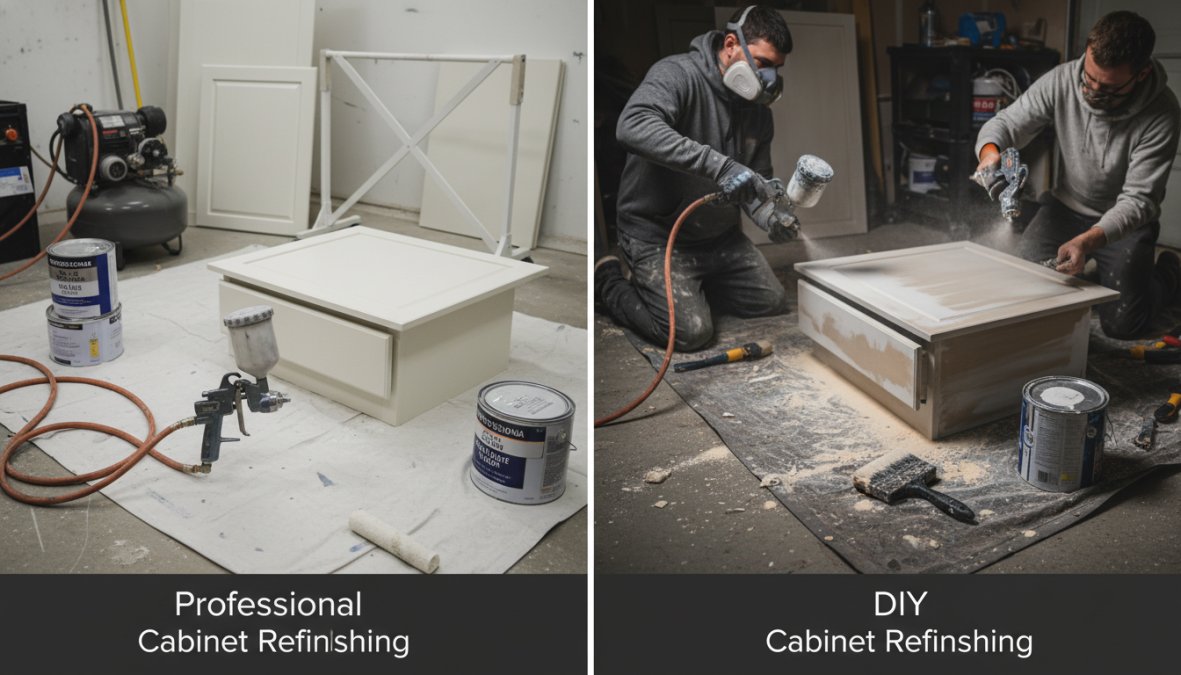
The gap between a professional finish and a DIY finish comes down to two things: equipment and process. Professional cabinet painters use HVLP (high-volume, low-pressure) spray equipment that atomizes paint into an even, fine mist. This produces a smooth, consistent finish without brush marks or roller texture. DIY painters using brushes and rollers produce visible texture, lap marks, and uneven sheen, particularly on flat cabinet faces where imperfections have nowhere to hide.
Honest pros of DIY:
- Lower upfront cost
- Complete schedule control
- Satisfying for experienced painters who already own spray equipment
Honest cons of DIY:
- Brush marks and roller texture are nearly impossible to eliminate without spray equipment
- Adhesion failures are common when surface preparation is skipped or rushed
- Runs, drips, and uneven coverage require sanding and recoating, multiplying time investment
- Topcoat selection is complex; the wrong product leads to early chipping and peeling
- Fumes and VOC exposure without professional ventilation equipment create health risks
Why Professional-Grade Tools and Surface Preparation Matter
Surface preparation is where professional cabinet refinishing earns its cost. It is also the step DIYers most consistently underestimate.
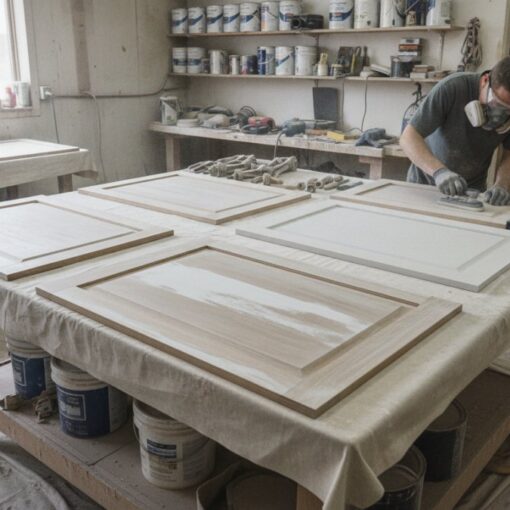
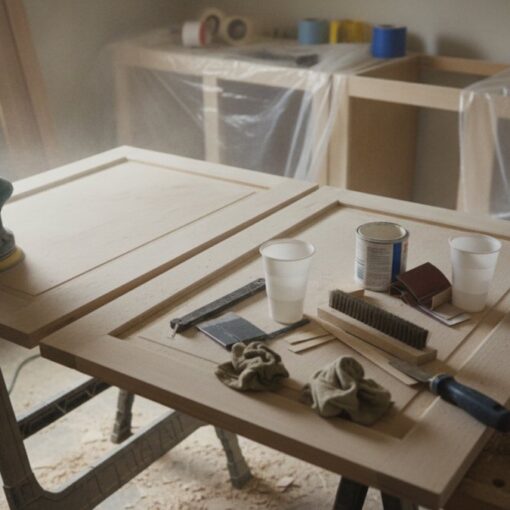
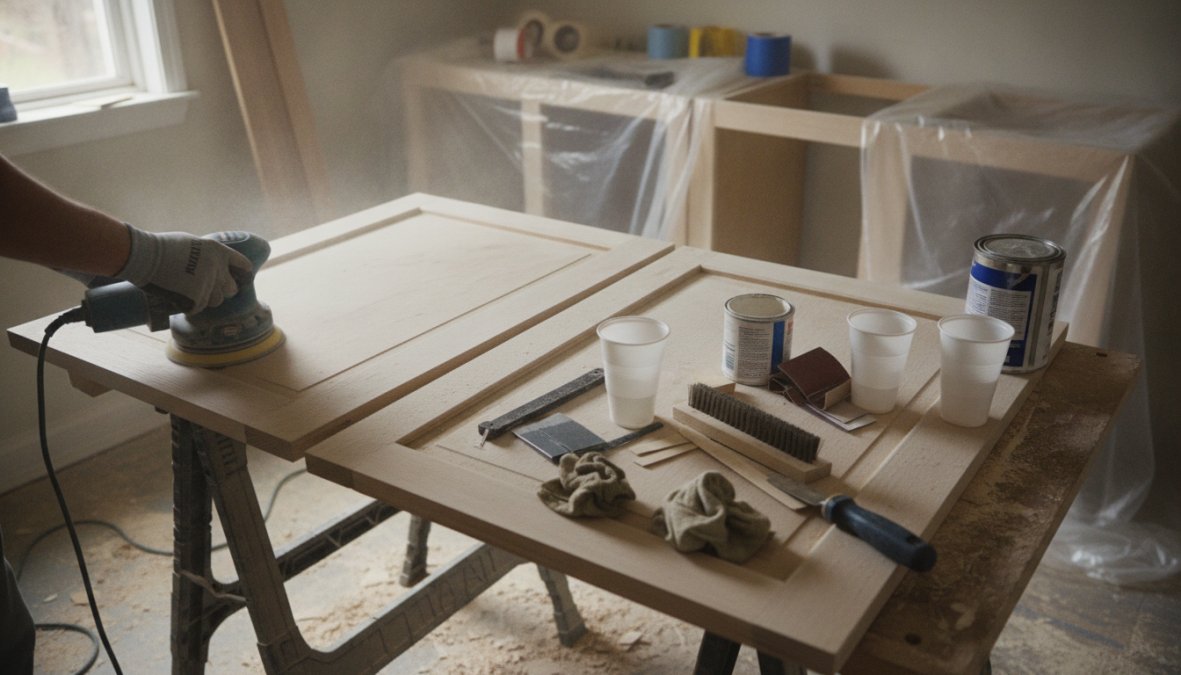
A professional process typically includes: degreasing all surfaces to remove cooking oils and residue, sanding to remove the existing finish and create mechanical adhesion for the primer, applying a bonding primer appropriate to the substrate, light sanding between coats, and applying two or more topcoats with a spray system.
Skip or rush any of those steps and the finish fails. Not eventually. Soon. Peeling paint on kitchen cabinets is almost always a surface preparation failure, not a product failure.
Denver Cabinet Painting Colorado treats preparation as the top priority in every project, which is why their finishes hold up under the daily wear of a working kitchen. The spray application process eliminates brush marks entirely, producing the factory-like finish that separates professional work from amateur attempts.
Never skip the degreasing step before sanding. Kitchen cabinets accumulate years of cooking oil and grease that standard sanding won’t remove. Painting over contaminated surfaces causes adhesion failure within months, regardless of how good the topcoat is.
How Long Does Cabinet Refinishing Take and Last?
A professional cabinet refinishing project typically takes two to five days for a standard kitchen, depending on cabinet count and finish complexity. Most professional contractors work in phases: removing doors and hardware on day one, completing prep and priming, then applying topcoats, and reinstalling once fully cured.
The turnaround time is significantly shorter than full cabinet replacement, which often involves weeks of lead time for custom orders plus multi-day installation.
Durability, Longevity, and Maintenance Guide
A professionally refinished cabinet, using proper surface preparation and a quality topcoat such as catalyzed polyurethane or conversion varnish, can realistically last ten years or more with basic maintenance. This is the number most guides omit, and it changes the cost-per-year math significantly.
Maintenance practices that extend finish life:
- Clean cabinet surfaces with a soft cloth and mild soap. Avoid abrasive cleaners or scrubbing pads that scratch the topcoat.
- Wipe up spills and grease immediately. Prolonged exposure to moisture and oils degrades any finish over time.
- Avoid steam exposure where possible. Position cabinet doors away from direct steam from kettles or pots.
- Check hinges and hardware annually. Loose hardware causes door misalignment that creates stress cracks at hinge points.
- Touch up minor chips early. Small chips addressed quickly prevent moisture from working under the finish and causing larger failures.
The finish type matters for maintenance too. A satin or semi-gloss sheen is more forgiving of cleaning than matte. Matte finishes show cleaning marks more readily and require more careful maintenance. For kitchen cabinetry specifically, satin is the most practical choice for most households.
Environmental Benefits, Chemical Safety, and VOCs
Cabinet refinishing is meaningfully more environmentally responsible than full cabinet replacement, and this angle deserves more attention than it typically receives.
Full cabinet replacement sends the existing cabinetry to landfill. A standard kitchen’s worth of cabinetry represents significant material volume: wood, MDF, particleboard, hardware, and finish coatings. Refinishing eliminates that waste stream entirely.
According to the EPA’s guidance on volatile organic compounds and indoor air quality, VOCs from paints and coatings are a significant contributor to indoor air pollution. This is the chemical safety angle most refinishing guides skip.
Professional-grade cabinet coatings contain VOCs that require proper ventilation during application and curing. A professional contractor manages this through controlled application environments, proper respiratory protection, and ensuring adequate cure time before homeowners return to the space. DIY applicators frequently underestimate VOC exposure risks, particularly in enclosed kitchen spaces.
The eco-friendly case for refinishing is strongest when the contractor uses low-VOC or waterborne topcoat formulations where performance requirements allow. Ask specifically about VOC content when getting quotes. Many professional-grade waterborne polyurethane products now deliver durability comparable to solvent-based systems with significantly lower VOC emissions.
Cabinet Material Compatibility and Color Selection
This is the section most refinishing guides skip entirely, and skipping it is a disservice to homeowners. Not all cabinet materials respond the same way to refinishing. The difference between a finish that holds for a decade and one that peels within a year often comes down to substrate, what your cabinets are actually made of, and whether the preparation process was matched to that specific material. Understanding your substrate before you get quotes will help you ask better questions and evaluate contractor proposals more critically.
A Practical Guide to Cabinet Material Compatibility
Solid Wood (Oak, Maple, Cherry, Hickory, Alder)
Solid wood is the ideal refinishing substrate. It accepts primer and topcoat reliably, holds mechanical adhesion well after sanding, and can be finished in either a painted solid color or a stained-and-topcoated natural wood look. Open-grain woods like oak have a pronounced grain texture that telegraphs through paint unless a grain-filling primer or high-build primer is used first, an important detail to confirm with your contractor if you want a smooth, flat painted finish rather than a visible-grain result. Closed-grain woods like maple and cherry produce a smoother painted surface with standard preparation.
Verdict: Excellent candidate for refinishing. Highest probability of a durable, long-lasting result.
MDF (Medium-Density Fiberboard), Door Faces and Drawer Fronts
MDF is a common material for painted cabinet door faces, particularly in shaker-style and flat-panel designs, because it machines cleanly and has no grain to telegraph through paint. It is a good refinishing candidate with one critical requirement: the edges and any routed profiles must be sealed with a high-build primer before topcoats are applied. MDF edges are highly porous and will absorb moisture from water-based coatings if not properly sealed, causing swelling and finish failure at the edges, the most common failure point on MDF cabinet doors.
MDF is not suitable for staining. It has no wood grain and will not absorb stain evenly. Painted finishes only.
Verdict: Good candidate for painted refinishing. Edge sealing is non-negotiable. Confirm your contractor’s primer specification for MDF substrates.
Plywood Cabinet Boxes with Wood Veneer Faces
Plywood boxes are structurally the most stable substrate in cabinetry, they resist moisture movement and warping better than particleboard. Veneer faces on plywood boxes can be refinished successfully with proper preparation, including light sanding to scuff the veneer surface without sanding through it (veneer layers are thin) and a bonding primer appropriate to the veneer species. The risk here is over-sanding: aggressive sanding on thin veneer faces can cut through to the plywood core, creating an uneven surface that shows through the finished topcoat.
Verdict: Good candidate. Requires careful sanding technique. Confirm your contractor has experience with veneered surfaces specifically.
Particleboard Core Cabinets
Particleboard is the most common core material in builder-grade and entry-level cabinetry. It is heavier than plywood, more susceptible to moisture damage, and less dimensionally stable over time. Particleboard cabinets in good condition, no swelling, no water damage, no failing joints, can be refinished successfully on their face frames and door faces. However, particleboard that has been exposed to moisture (common under sinks and around dishwashers) swells and crumbles in a way that cannot be corrected by refinishing. Those areas require replacement regardless of the overall refinishing scope.
Verdict: Acceptable candidate if structurally sound. Inspect carefully for moisture damage before committing to refinishing. Damaged particleboard sections should be replaced, not painted over.
Thermofoil Cabinets
Thermofoil is a vinyl film heat-pressed over an MDF substrate. It is common in builder-grade kitchens from the 1990s through the 2010s. Thermofoil presents the most complex refinishing scenario. The vinyl surface is non-porous and requires a bonding primer specifically formulated for flexible or non-porous substrates, standard primers will not adhere reliably. More importantly, thermofoil that is already delaminating (peeling away from the MDF core, particularly around heat sources like dishwashers and ovens) must be fully removed before any primer or topcoat is applied. Painting over delaminating thermofoil traps the failure and accelerates it.
When thermofoil is intact and a proper bonding primer is used, painted refinishing can produce a durable result. When thermofoil is actively delaminating, the honest recommendation is to strip the thermofoil entirely, address the MDF substrate, and then refinish, or to replace the affected doors.
Verdict: Possible candidate with correct preparation, but requires careful inspection and substrate-specific primer. Delaminating thermofoil must be addressed before painting.
Laminate Surfaces (High-Pressure Laminate / Formica-Style)
High-pressure laminate surfaces are non-porous and present the most significant adhesion challenge of any common cabinet material. Standard primers will not bond reliably to laminate without mechanical abrasion (scuff sanding) and a bonding primer specifically formulated for non-porous substrates. Even with correct preparation, laminate refinishing carries a higher long-term adhesion risk than wood or MDF substrates, particularly in high-moisture or high-heat zones. Some professional refinishers decline laminate projects for this reason; others accept them with appropriate client expectations about longevity.
Verdict: Challenging candidate. Requires substrate-specific bonding primer and realistic expectations about long-term durability. Ask your contractor directly whether they warrant laminate refinishing on the same terms as wood or MDF.
Before accepting any refinishing quote, ask the contractor to identify your cabinet substrate and explain their primer specification for that specific material. A contractor who gives the same preparation answer regardless of substrate, “we sand and prime everything the same way”, is a red flag. Substrate-matched preparation is the technical foundation of a durable finish.
Material Compatibility at a Glance
| Cabinet Material | Refinishing Suitability | Key Preparation Requirement | Stainable? |
|---|---|---|---|
| Solid wood (oak, maple, cherry) | Excellent | Grain filler for open-grain species | Yes |
| MDF door faces | Good | High-build primer on edges | No |
| Plywood with wood veneer | Good | Careful sanding, bonding primer | Sometimes |
| Particleboard (sound condition) | Acceptable | Inspect for moisture damage first | No |
| Thermofoil (intact) | Possible | Bonding primer; remove delaminating sections | No |
| High-pressure laminate | Challenging | Scuff sand + bonding primer; lower longevity | No |
Color Selection: Making the Right Choice for Your Kitchen
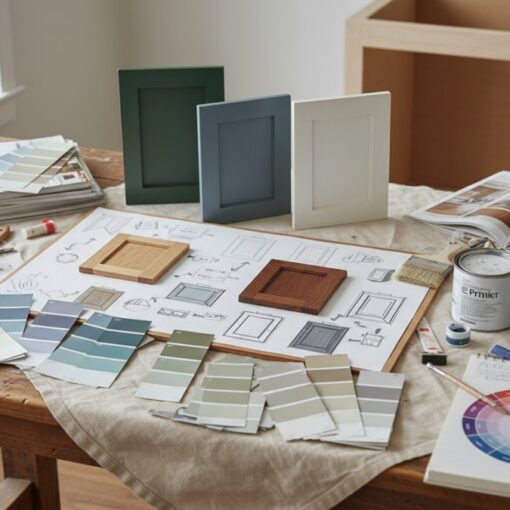
Custom color selection is one of the genuine advantages of professional refinishing over stock replacement cabinetry. A professional refinishing contractor can match virtually any color from any paint brand’s fan deck, or custom-tint to a specific sample, giving you design flexibility that stock cabinet lines cannot match.
Practical color guidance:
- White and off-white tones remain the most popular choice for refinished cabinetry, according to Houzz’s annual kitchen trends report. They photograph well, appeal broadly to buyers, and make spaces feel larger, but they show dust, smudges, and wear more readily than darker tones, making sheen selection important (satin is more forgiving than matte for white cabinets in a working kitchen).
- Gray tones have been the dominant trend for the past decade and remain a safe, broadly appealing choice that reads as contemporary without being trend-dependent.
- Deep blues and greens (navy, slate blue, sage, forest green) are the fastest-growing category in kitchen refinishing. They work particularly well on islands or lower cabinets in two-tone designs, paired with white or off-white upper cabinets.
- Two-tone designs, a different color on the island versus perimeter cabinets, or upper versus lower cabinets, are a design approach that refinishing handles particularly well, since the contractor is already working with individual components. The cost premium over a single-color job is modest relative to the design impact.
Sheen selection matters as much as color:
Matte finishes are visually sophisticated but the least forgiving in a kitchen environment. They show cleaning marks, require more careful maintenance, and are harder to wipe clean without leaving streaks. Satin is the most practical sheen for kitchen cabinetry: it cleans easily, hides minor surface imperfections better than semi-gloss, and reads as refined without the high-reflectivity of a gloss finish. Semi-gloss is durable and easy to clean but amplifies surface imperfections, it is unforgiving on anything less than a perfectly smooth substrate.
If you’re planning to sell within two to three years, choose a neutral color in satin sheen. White, soft white, or a warm gray in satin finish photographs well for listings, appeals to the broadest buyer pool, and signals a well-maintained, move-in-ready kitchen, which is exactly the perception shift that drives resale value recovery on a refinishing investment.
Is Cabinet Refinishing Worth the Money? Final Verdict
The honest answer: yes, for the majority of homeowners with structurally sound cabinetry who want a significant aesthetic transformation without the cost and disruption of full replacement.
Cabinet refinishing is worth the money when your boxes are solid, your layout works, and your goal is a fresh, high-quality finish that holds up for years. It is the highest-value kitchen update available on a per-dollar basis, particularly when professional surface preparation and spray application are part of the process.
It is less compelling when doors are warped or delaminating, when the cabinet construction is failing, or when a layout change is genuinely needed. In those cases, refacing or replacement becomes the more logical investment.
The DIY versus professional question has a clear answer for anyone who wants a factory-like finish: hire a professional. The equipment gap is too large to bridge with brushes and rollers, and a failed DIY finish costs more to fix than the professional job would have cost initially.
For Colorado homeowners specifically, the combination of high-altitude climate conditions and the state’s competitive real estate market makes professional cabinet refinishing a particularly sound investment. Fresh cabinetry photographs well, shows well, and signals a well-maintained home to buyers.
Outdated kitchen cabinetry is one of the most common reasons Colorado homeowners feel their space no longer reflects the home they want. Denver Cabinet Painting Colorado brings 40 years of experience to every project, specializing in cabinet painting, refinishing, and glazing with meticulous surface preparation and professional spray application that produces smooth, consistent finishes built to last. Get a free quote from Denver Cabinet Painting Colorado and find out what a professionally refinished kitchen looks like in your space.
Frequently Asked Questions
How much does cabinet refinishing cost compared to full replacement?
Cabinet refinishing typically costs a fraction of full cabinet replacement. While replacement can run tens of thousands of dollars including new cabinetry and installation, professional refinishing focuses only on the surface, sanding, priming, and applying a durable topcoat. This makes it one of the most cost-effective kitchen renovation options available. Exact pricing varies based on cabinet count, material, and finish type, so getting a free quote from a local professional is the best way to compare your specific options.
How long does cabinet refinishing last when done professionally?
A professionally applied cabinet refinishing job can last 10 years or more with proper care. Longevity depends on surface preparation quality, the type of topcoat used, such as polyurethane or a catalyzed finish, and how well the cabinets are maintained afterward. Avoiding harsh cleaners, wiping up spills quickly, and using soft cloths for cleaning all extend the life of the finish significantly. DIY refinishing tends to wear faster due to inconsistent adhesion and lower-grade materials.
Is it better to paint or refinish kitchen cabinets?
Cabinet refinishing and cabinet painting are closely related, but refinishing typically involves more thorough surface preparation, including stripping, sanding, and priming, before a topcoat is applied. This results in a more durable, factory-like finish with better adhesion. Professional cabinet painting using spray equipment can also achieve a smooth, brush-mark-free result. Both are far more cost-effective than replacement, and the right choice depends on your cabinet material, current condition, and desired sheen level such as matte or satin.
Can you refinish cabinets yourself to save money?
DIY cabinet refinishing is possible but comes with real risks. Without professional-grade spray equipment, achieving a smooth finish free of brush marks and imperfections is difficult. Proper surface preparation, including sanding, degreasing, and priming, is critical for adhesion and durability. Skipping or rushing these steps leads to peeling and chipping within months. For homeowners weighing professional cabinet refinishing vs. DIY, the time investment, material costs, and risk of a poor result often make hiring a professional the better value.
Does cabinet refinishing add value to your home?
Yes, cabinet refinishing can meaningfully improve your home's resale value by modernizing the kitchen's appearance at a low cost. Kitchens are one of the top rooms buyers evaluate, and updated cabinetry, even through refinishing rather than replacement, creates a strong first impression. A high-end finish in a neutral or on-trend custom color can make the space feel renovated without the expense of new cabinetry, giving sellers a solid return on a relatively modest investment.
What cabinet materials are compatible with professional refinishing?
Most solid wood, MDF, and plywood cabinet boxes and doors are excellent candidates for professional refinishing. Thermofoil and laminate surfaces can be more challenging, adhesion requires careful preparation and the right primers. Cabinets with significant structural damage, warping, or delamination may not refinish well and could be better candidates for refacing or replacement. A professional assessment helps determine compatibility and ensures the right surface preparation techniques and products are used for a lasting result.
This article was written using GrandRanker