Table of Contents
- Cabinet Glazing vs Solid Paint Finish: Understanding the Core Difference
- How to Apply a Glaze vs a Solid Paint Finish: Step-by-Step
- Pros and Cons of Glazed Cabinets vs Solid Paint
- Cost of Cabinet Glazing vs Painting: What to Budget
- Durability, Compatibility, and Long-Term Maintenance of Each Finish
- Modern Kitchen Cabinet Finish Trends: Where Glazing and Solid Paint Stand in 2026
- Cabinet Glazing vs Solid Paint Finish: Which One Should You Choose?
- Conclusion
Last Updated: May 27, 2026
Choosing between cabinet glazing vs solid paint finish is one of the most consequential decisions you’ll make during a kitchen renovation, and most homeowners get it wrong by defaulting to whatever looks good in a showroom. At Denver Cabinet Painting Colorado, we’ve spent 40 years helping Colorado homeowners and commercial clients navigate exactly this choice, and the answer is rarely obvious. Below, we’ll walk you through every meaningful difference between these two finishes, including how to apply them, what they cost, how they hold up over time, and which one actually fits your kitchen in 2026.
Here’s what most guides get wrong: they treat glazing as simply a stylistic upgrade to painted cabinets. It isn’t. Glazing is a fundamentally different finishing system with its own application logic, durability profile, and long-term maintenance demands.
Cabinet Glazing vs Solid Paint Finish: Understanding the Core Difference
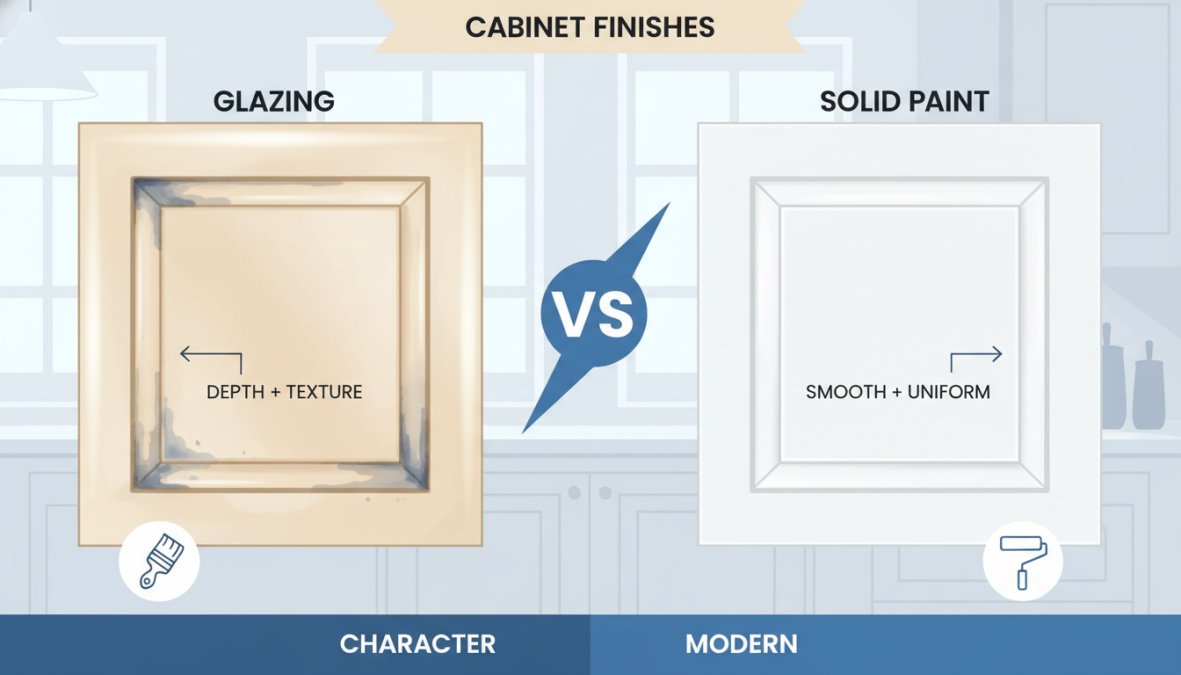
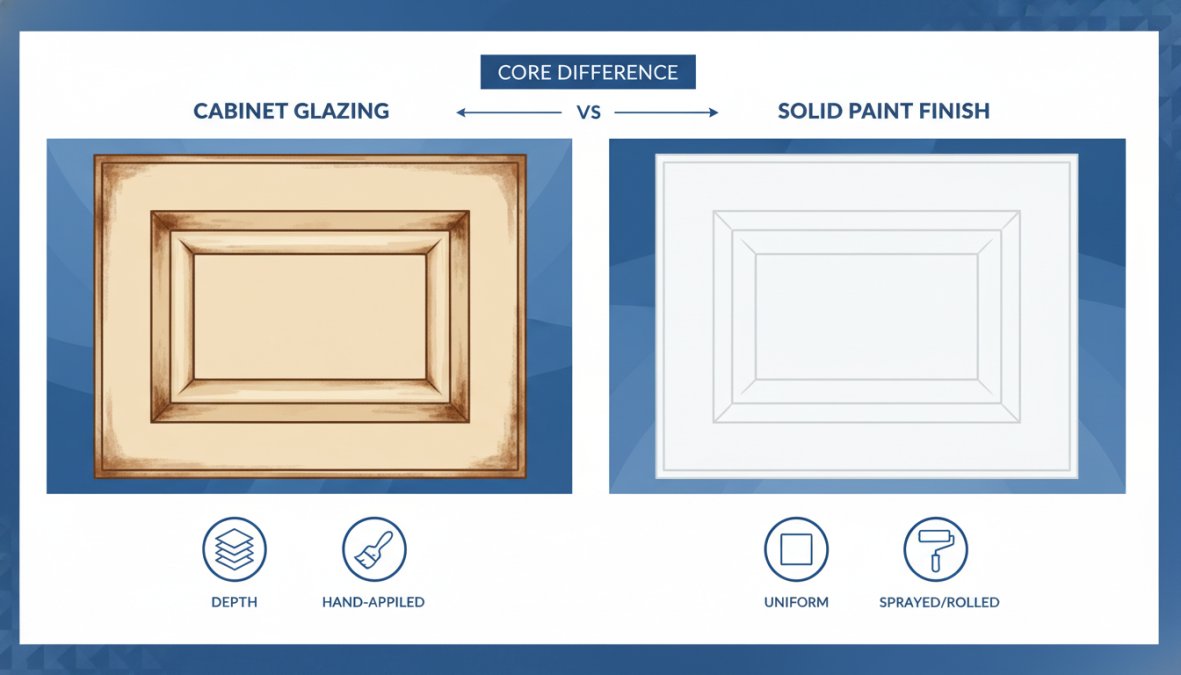
The core difference between cabinet glazing and a solid paint finish comes down to opacity and intent. A solid paint finish covers a surface completely and uniformly. A glaze is a semi-transparent, tinted layer applied over a cured basecoat to add depth, shadow, and visual texture.
What Is Cabinet Glazing?
Cabinet glazing is the application of a translucent layer of tinted medium over a fully cured paint or stain basecoat, then selectively wiped back to leave color concentrated in recessed areas, molding profiles, and carved details. The result is a dimensional effect that mimics the aged look of antique furniture, where years of use have darkened the low points of a piece.
Products like General Finishes Glaze Effects use a water-based, translucent formula with extended open time, which gives applicators the workability needed to blend and wipe before the medium sets. The glaze sits on top of the basecoat rather than penetrating it, which means the underlying color remains the visual foundation. Antiquing, distressing, and pinstripe glaze techniques all fall under this category.
What Is a Solid Paint Finish?
A solid paint finish is a fully opaque coating that covers the cabinet substrate completely, delivering a uniform appearance with no visible variation in color or depth. Modern cabinet-grade paints like Benjamin Moore Advance Interior Paint and Sherwin-Williams Emerald Urethane Trim Enamel are waterborne alkyd or urethane-modified alkyd formulas that cure to a hard, furniture-quality surface. There is no translucent layer, no wiping technique, and no intentional texture variation. The finish is what you see: clean, consistent, and flat in its visual presentation.
The distinction matters because these two systems serve entirely different design goals. Glazing adds richness and architectural complexity. Solid paint delivers clarity and precision.
How to Apply a Glaze vs a Solid Paint Finish: Step-by-Step
Application technique separates a professional result from a DIY disaster on both finishes. The processes are more different than most people expect.
Applying a Cabinet Glaze
Glazing requires a fully cured, sealed basecoat before you touch a glaze product. Rushing this step is the single most common mistake.
- Prepare the surface: Clean cabinets thoroughly, sand with 220-grit, and apply a vinyl sealer or lacquer-compatible primer appropriate to your basecoat system.
- Apply the basecoat: Spray or brush two coats of your chosen paint, allowing full cure time (typically 24-72 hours depending on the product).
- Mix the glaze: Combine your acrylic glaze or oil-based stain medium with colorants to achieve the desired tone. Darker glazes produce more dramatic antiquing effects.
- Apply the glaze: Brush the glaze product generously over the cabinet surface, working it into recessed panels, molding profiles, and decorative details.
- Wipe back: Using a lint-free cloth, wipe off the excess glaze from the raised surfaces while leaving it concentrated in the low points. This is the wipe-off glaze technique that creates the dimensional effect.
- Seal with a topcoat or clear coat: A protective topcoat is non-negotiable. General Finishes Glaze Effects, for example, explicitly requires a clear coat after application.
Never apply a glaze over an uncured basecoat. The solvent in the glaze medium can lift or wrinkle fresh paint, destroying the basecoat and forcing a complete restart. Allow full cure time, not just dry-to-touch time.
Applying a Solid Paint Finish
A solid paint finish demands obsessive surface preparation. The finish is unforgiving: every sanding scratch, grain raise, and filler imperfection will telegraph through the topcoat.
- Strip and clean: Remove all hardware, degrease with TSP substitute, and lightly sand existing surfaces to promote adhesion.
- Fill and prime: Fill any dents or grain with a quality wood filler, sand smooth, then apply a bonding primer appropriate to your paint system.
- Sand between coats: After the primer dries, sand with 220-grit to eliminate any raised grain or dust nibs.
- Apply paint: Spraying produces the smoothest, most uniform appearance. Brushing is viable with high-leveling formulas like Sherwin-Williams Emerald Urethane, which is designed to self-level and minimize visible brush marks.
- Apply two to three finish coats: Allow proper recoat windows. Benjamin Moore Advance requires 16 hours between coats, which is longer than standard latex but produces a harder cure.
- Final topcoat (optional): High-performance enamels like Sherwin-Williams Emerald Urethane are self-sealing and do not require a separate clear coat, which reduces total project time.
When spraying a solid finish, thin your paint only according to the manufacturer’s specification. Over-thinning to improve atomization reduces film build and leads to premature wear on high-contact areas like door edges and drawer fronts.
Pros and Cons of Glazed Cabinets vs Solid Paint
Most comparisons of glazed cabinets versus solid paint stop at aesthetics and application complexity. That framing is incomplete. The decision has real implications for renovation ROI, long-term material compatibility, and how each finish holds up against the specific substrate your cabinets are actually made from. This section covers what the standard trade-off lists miss.

The Standard Trade-Off Table (With the Caveats Most Guides Omit)
| Feature | Cabinet Glazing | Solid Paint Finish |
|---|---|---|
| Visual depth | High, dimensional, layered, shadow-dependent | Low, flat, uniform, consistent |
| Aging appearance | Intentional aged look baked into the design | Stays consistent; aging shows as wear, not character |
| Application complexity | High, requires practiced wipe-off technique | Moderate, surface prep is critical but process is linear |
| Spot repair ease | Difficult, glaze matching degrades over time | Easier, leftover paint from the original job handles most repairs |
| Design style fit | Traditional, transitional, Old World | Modern, contemporary, Scandinavian, transitional |
| Required topcoat | Yes, mandatory, not optional | Often self-sealing with premium enamels |
| Substrate sensitivity | High, performs differently on MDF vs. solid wood | Moderate, more forgiving across substrate types |
| Renovation resale signal | Mixed, reads as dated to some buyers, premium to others | Broadly neutral to positive across buyer demographics |
What the Table Cannot Tell You: Substrate Compatibility
This is the variable most homeowners and many online guides ignore entirely, and it is the one most likely to determine whether your finish investment holds up.
Solid wood doors with raised panels: The ideal substrate for glazing. The grain structure of species like maple, cherry, and alder creates natural micro-variation in how the glaze settles, slightly more pigment pools in open-grain areas, slightly less on tight-grain surfaces, which produces the authentic handcrafted depth that makes glazing worth the cost. Solid paint on the same substrate is perfectly viable but leaves the grain’s character unused.
MDF (medium-density fiberboard): Both finishes work on MDF, but with important caveats. MDF has no grain, which means a glaze applied to an MDF door produces a flatter, less dimensional result than the same glaze on solid wood, you get the color pooling in the recessed panel profile, but none of the grain-level texture variation. More critically, MDF absorbs moisture aggressively at edges and cut surfaces. A glaze medium applied over inadequately sealed MDF edges can cause localized swelling that telegraphs through the finish within one to two years. Solid paint on properly primed MDF is more forgiving because the application process does not involve a wet medium being worked into surface details for an extended open time.
Thermofoil and laminate: Neither traditional glazing nor standard cabinet paint adheres reliably to thermofoil or laminate without specialized bonding primers and mechanical surface preparation. Thermofoil is a vinyl film heat-bonded to MDF; its surface is designed to resist adhesion. Attempting to glaze over thermofoil without proper prep, typically a scuff sand and a shellac-based or adhesion-promoting primer, is a refinishing failure waiting to happen. If your cabinets are thermofoil, the substrate question must be resolved before the finish question.
Plywood box construction with solid wood doors: The most common configuration in quality cabinetry built from the 1980s onward. Both finishes perform well here. The plywood boxes take solid paint cleanly; the solid wood doors respond to glazing in the way the technique was designed for.
The Renovation ROI Angle: Is Glazing ‘Out of Style’?
This is the question homeowners actually ask when they are planning a renovation with resale in mind, and it deserves a direct answer rather than a diplomatic hedge.
Glazing is not out of style. It is out of context in the kitchens where it is currently being applied. The heavy, dark antiquing glaze over cream-painted raised-panel doors that defined the early 2000s kitchen aesthetic has receded, not because glazing as a technique is dated, but because that specific combination (dark glaze, ornate door profile, warm cream base) reads as a period style marker the way harvest gold appliances do. Buyers in 2026 recognize it as a specific era.
A well-executed, restrained glaze, a light gray wash over a warm white base on a quality raised-panel door, or a subtle pinstripe glaze that adds depth without drama, does not read as dated. It reads as craftsmanship. The distinction is in the weight of the application and the door profile it is applied to.
For renovation ROI purposes, the practical guidance is:
- If your cabinets have strong architectural profiles (raised panels, corbels, decorative molding) and your home’s overall style is traditional or transitional, a restrained glaze finish adds perceived value that a solid paint job on the same cabinetry does not.
- If your cabinets are shaker or flat-panel style, a solid paint finish in a current color, sage green, warm white, slate blue, greige, is the stronger ROI choice. Glazing a shaker door produces minimal visual benefit and signals a finish mismatch to buyers who understand cabinetry.
- If you are refinishing to sell within two to three years, solid paint in a neutral, broadly appealing color is the lower-risk choice regardless of door style. It reads as clean and updated to the widest range of buyers.
Glazed Cabinets: Where They Win
- Adds genuine depth and richness to raised-panel doors and ornate cabinetry that solid paint cannot replicate
- Creates a one-of-a-kind, handcrafted appearance, no two glaze applications are identical
- Excellent for traditional, Old World, and transitional kitchen styles where the door profile justifies the technique
- On solid wood substrates, highlights the natural grain in a way that makes the material itself part of the finish
- A restrained application ages gracefully in a way that solid paint does not, minor wear in a glazed finish often reads as patina rather than damage
Glazed Cabinets: Where They Fall Short
- Spot repair is genuinely difficult: matching a glaze application after years of UV exposure, cleaning, and ambient aging requires a full-door refinish in most cases, not a localized touch-up
- Semi-transparent glaze layer shows grease and cleaning residue differently than solid paint, the color pooling in recessed areas can accumulate grime that is harder to clean without dulling the topcoat
- Not appropriate for flat-panel, slab-door, or contemporary cabinetry, the technique requires architectural detail to work
- Substrate-sensitive: performs best on solid wood, requires careful prep on MDF, and is not viable on thermofoil without specialized surface preparation
Solid Paint: Where It Wins
- Cleaner, more modern aesthetic that suits the dominant design direction of 2026 kitchen renovations
- Easier to touch up: leftover paint from the original project handles most spot repairs without visible seams
- Consistent appearance across all door styles, works on shaker, flat-panel, and raised-panel equally
- More forgiving across substrate types, particularly on MDF where glaze medium can cause edge issues
- Broader effective color palette, without the visual layering of a glaze, colors read more accurately to their chip
- Self-sealing premium enamels like Sherwin-Williams Emerald Urethane eliminate the mandatory topcoat stage, reducing both cost and project timeline
Solid Paint: Its Honest Limitation
A uniform appearance is exactly that: uniform. There is no visual complexity, no depth from shadow play in recessed details, no grain character. On a flat-panel shaker door, that is a feature, the finish and the door profile are aligned. On a raised-panel door with strong architectural detail, a solid paint finish leaves the cabinetry’s best visual asset unused. The door is doing the work; the finish is not helping it.
Before committing to either finish, photograph your cabinet door profile in raking light, a single light source held at a sharp angle to the door face. This reveals the actual depth and shadow lines in the profile. If the raking light produces strong shadow definition in the recessed panel and molding details, that door profile will reward a glaze. If the profile is shallow or the door is flat, solid paint is the aligned choice.
Cost of Cabinet Glazing vs Painting: What to Budget
The cost of cabinet glazing vs painting is one of the most searched sub-questions in this topic, and most guides either dodge it entirely or offer numbers so broad they are useless. This section gives you a practical framework for evaluating real quotes, not invented figures, but the cost drivers and scope variables that determine where your project lands.
Why Glazing Costs More: The Mechanism, Not Just the Label
The price premium for glazing over solid paint is not arbitrary. It is the direct result of three compounding factors that add labor hours and material cost to every project:
1. Mandatory multi-stage cure windows
A glaze cannot be applied over a fresh basecoat. The basecoat must reach full cure, not just dry-to-touch, before the glaze medium goes on. Depending on the paint system, that cure window is 24 to 72 hours. Then the glaze itself must cure before the mandatory clear topcoat is applied. On a typical kitchen cabinet project, this staging alone adds one to two full working days compared to a straight solid paint job, and labor time is the largest cost variable in any refinishing project.
2. Skill-intensive application that cannot be rushed
The wipe-off glaze technique requires a practiced, consistent hand. An applicator who wipes too aggressively removes too much glaze and loses the dimensional effect. One who wipes too lightly leaves blotchy, uneven color pooling. Correcting a bad glaze application often means stripping back to the basecoat and starting the glaze stage over, which is why experienced glazing contractors charge a skill premium that solid paint work does not command at the same level.
3. Mandatory topcoat as a separate billable stage
Products like General Finishes Glaze Effects explicitly require a protective clear coat after application. This is not optional. That topcoat is an additional material cost and an additional labor stage. High-performance solid paint enamels like Sherwin-Williams Emerald Urethane Trim Enamel are self-sealing and require no separate topcoat, which removes an entire billable stage from the solid paint workflow.
How to Evaluate a Contractor Quote for Either Finish
When you receive a quote for cabinet refinishing, the line items to scrutinize are the same regardless of finish type:
- Door count and drawer front count: These are the highest-labor components. A kitchen with 30 doors and 15 drawer fronts is a fundamentally different scope than one with 18 doors and 8 drawer fronts, and the price should reflect it proportionally.
- Box painting inclusion: Are the cabinet boxes (interior and exterior faces) included, or is the quote door-and-drawer-front only? Glazing the boxes to match the doors adds significant time because the wipe-off technique must be applied consistently across flat, undetailed surfaces where inconsistency is more visible.
- Prep and repair scope: Surface preparation, filling, sanding, priming, is where corners get cut on low bids. Ask specifically what prep is included and whether grain raising on solid wood doors is addressed before the basecoat.
- Topcoat specification: For glazing quotes, confirm that a clear topcoat is included and ask what product will be used. A water-based polyurethane topcoat and a conversion varnish topcoat have meaningfully different durability profiles and costs.
- Number of finish coats: Two finish coats is the professional standard for solid paint. A glaze system should include basecoat (two coats), glaze application, and topcoat (one to two coats), five distinct application stages minimum.
The Refinishing vs. Replacement Calculation
For homeowners weighing cabinet refinishing against full replacement, both glazing and solid paint represent substantial savings. Full cabinet replacement, new boxes, new doors, new hardware, installation, is one of the most expensive single-line items in a kitchen renovation. Refinishing existing cabinetry, even with a premium glaze system, costs a fraction of that figure for kitchens where the box construction is structurally sound.
The relevant question is not whether refinishing is cheaper than replacement (it almost always is), but whether the finish system you choose is appropriate for the substrate you have. Investing in a full glaze system on cabinets with MDF doors that are beginning to delaminate at the edges is a poor allocation of refinishing budget. A solid paint finish on those same cabinets, with proper edge sealing and priming, extends their functional life at a lower cost and positions you for a full replacement on your own timeline rather than the cabinet’s.
National Kitchen and Bath Association renovation cost guidance
The most useful question to ask any contractor is not ‘what is your price?’ but ‘how many stages does your process include and what is the cure window between each one?’ A glazing quote that does not account for multi-day staging between basecoat, glaze, and topcoat is either underpriced (meaning shortcuts will be taken) or the contractor is not experienced with the process. Either way, it is a red flag.
Durability, Compatibility, and Long-Term Maintenance of Each Finish
This is the part most renovation guides skip entirely, and it is where real-world decisions get made.
Glazed Cabinets: Long-Term Maintenance and Repair
Glazed cabinets require more careful ongoing maintenance than solid painted surfaces. The semi-transparent glaze layer sits between the basecoat and topcoat, which means any damage to the clear coat exposes the glaze to direct wear, moisture, and cleaning chemicals.
A common mistake is using abrasive cleaners on glazed cabinets. Even mild scrubbing pads can dull the topcoat over time, which changes how light interacts with the glaze beneath and produces uneven sheen across the door face. Soft cloths and pH-neutral cleaners are the correct approach.
Spot repair on glazed cabinets is genuinely difficult. Matching a glaze application after years of aging, UV exposure, and cleaning requires skill and often a full-door refinish rather than a localized touch-up. If you are planning a kitchen you intend to update in five to seven years, this is a manageable trade-off. If you want a finish that ages gracefully and repairs easily, solid paint has a structural advantage.
Solid Paint Finish: How to Clean Painted Kitchen Cabinets
Knowing how to clean painted kitchen cabinets correctly extends the life of any solid finish significantly. The process is straightforward but the details matter:
- Use warm water with a small amount of dish soap for routine cleaning
- Wipe in the direction of the wood grain to avoid micro-scratching the finish
- Dry immediately after cleaning, particularly around sink areas and high-steam zones
- Avoid ammonia-based cleaners, which can dull gloss finishes over time
- For stubborn grease, a diluted white vinegar solution works without damaging cured enamel
High-performance enamels like Sherwin-Williams Emerald Urethane are specifically engineered to resist scrubbing, which makes them well-suited to kitchen environments. The urethane-modified formula cures to a hard shell that handles daily cleaning without degrading.
Compatibility With Modern Cabinet Materials
This is an angle most guides miss entirely. Not every finish is compatible with every cabinet substrate, and modern kitchens increasingly feature materials that behave differently from traditional solid wood.
MDF (medium-density fiberboard): Both glazing and solid paint work on MDF, but MDF requires careful priming because it absorbs moisture aggressively at edges and cut surfaces. A solid paint finish is generally more forgiving on MDF than glazing, because the glaze medium can cause edge swelling if the substrate is not properly sealed.
Thermofoil and laminate: Neither traditional glazing nor standard paint adheres reliably to thermofoil or laminate without specialized bonding primers and surface preparation. Attempting to glaze over thermofoil without proper prep is a cabinet refinishing failure waiting to happen.
Plywood box construction with solid wood doors: The most common configuration in quality cabinetry. Both finishes perform well here. Solid wood doors respond beautifully to glazing because the grain structure creates natural variation in how the glaze settles, highlighting the grain in a way MDF cannot replicate.
According to Architectural Woodwork Standards published by the Architectural Woodwork Institute, substrate preparation is the single most critical variable in finish performance, regardless of the coating system applied.
Modern Kitchen Cabinet Finish Trends: Where Glazing and Solid Paint Stand in 2026
The current design landscape has shifted decisively toward solid paint finishes, and the numbers in cabinet refinishing requests reflect it. Flat-panel and shaker-style cabinetry in muted, nature-inspired tones dominate 2026 kitchen renovations: sage green, warm white, slate blue, and greige are the colors driving the most cabinet painting projects across the Denver metro area.
Glazing has not disappeared, but its role has narrowed. It remains the right choice for traditional and transitional kitchens where raised-panel doors, corbels, and decorative molding create the architectural detail that makes a glaze worthwhile. The antiquing and distressing techniques that defined the early 2000s kitchen aesthetic have given way to cleaner, more restrained interpretations: a subtle pinstripe glaze on a warm cream base, or a light gray wash over white that adds depth without the heavy Old World drama.
The contrarian insight here is worth stating directly: glazing is not a dated technique. It is a misapplied one. Applied to the right cabinetry, a well-executed glaze finish is more visually sophisticated than any solid paint job. Applied to a flat-slab door in a contemporary kitchen, it looks like a mistake.
For homeowners following the current trend toward contemporary and transitional styles, a solid paint finish with a semi-gloss or satin sheen in a current color is the stronger choice. For those renovating period homes or traditional-style kitchens, glazing deserves serious consideration.
As noted in Houzz Kitchen Trends Report, white and off-white remain the dominant cabinet colors in North American kitchen renovations, with painted finishes outpacing stained wood by a significant margin. This trend reinforces the relevance of solid paint as the baseline finish choice for most 2026 kitchen projects.
Cabinet Glazing vs Solid Paint Finish: Which One Should You Choose?
The right answer depends on three variables: your cabinet door style, your design aesthetic, and your tolerance for long-term maintenance.
Choose cabinet glazing if:
- Your cabinets have raised panels, ornate profiles, or decorative molding that creates shadow lines for the glaze to settle into
- Your kitchen style is traditional, transitional, or Old World
- You want a finish with genuine visual complexity and depth
- You are working with a professional who has demonstrable glazing experience
Choose a solid paint finish if:
- Your cabinets are shaker, flat-panel, or slab-door style
- Your kitchen aesthetic is contemporary, modern, or Scandinavian-influenced
- You want a finish that is easier to touch up and maintain over time
- You are working within a tighter budget
The one thing that should not drive this decision is trend-following alone. Glazed cabinets in a home with strong traditional architecture will outlast any trend cycle. Solid paint on a contemporary kitchen will always look current because the style itself is the constant.
For anyone uncertain about which direction fits their specific cabinetry, the practical move is a professional consultation. The door profile and substrate material alone will often answer the question before color or style even enters the conversation.
A useful framework from This Old House guide to cabinet finishing reinforces the same logic: match the finish complexity to the architectural complexity of the cabinet. Simple doors, simple finish. Complex doors, complex finish.
Conclusion: Making the Decision With Confidence
The cabinet glazing vs solid paint finish decision is not a matter of one being better than the other. They are different tools for different jobs. Glazing adds dimensional richness to traditional cabinetry. Solid paint delivers clean, durable uniformity that suits modern design and everyday maintenance demands.
Choosing the wrong finish for your cabinetry style is an expensive mistake, and it is one that professional guidance prevents. Denver Cabinet Painting Colorado has spent 40 years refining both glazing and solid paint applications across residential and commercial kitchens throughout Colorado, with an emphasis on meticulous surface preparation and smooth, consistent finishes that hold up in real kitchen environments. Whether your project calls for a full glaze system or a clean coat of premium enamel, get a free quote from Denver Cabinet Painting Colorado and start your cabinet refinishing project with a team that knows the difference.
Frequently Asked Questions
What is the difference between glazed and painted cabinets?
Cabinet glazing involves applying a semi-transparent, translucent layer of tinted glaze over a cured basecoat to add depth, dimension, and an aged look, often pooling in low points and recessed details for an antiquing effect. A solid paint finish, by contrast, delivers a uniform appearance with full, opaque color coverage from basecoat to topcoat. Glazing highlights the cabinet's architecture and texture, while solid paint creates a clean, consistent look across the entire surface.
Does glazing make cabinets look dirty?
Not when applied correctly. Cabinet glazing is a deliberate decorative painting technique that intentionally darkens crevices and low points to create a dimensional, aged look rather than a dirty appearance. The key is using the right colorant ratio and a proper wipe-off glaze technique. A well-applied glaze adds richness and depth. However, if the glaze is too heavy or unevenly distributed, it can look muddy, which is why professional application and a protective clear coat topcoat are strongly recommended.
Is a solid paint finish more durable than a glazed finish?
A solid paint finish using a high-quality product like Benjamin Moore Advance or Sherwin-Williams Emerald Urethane Trim Enamel can be extremely durable on its own. Glazed cabinets require an additional protective topcoat or lacquer over the glaze layer, which adds durability but also adds a step. When both are properly sealed, durability is comparable, though solid paint finishes tend to be slightly easier to touch up because there's no glaze pattern to match during cabinet refinishing repairs.
Are glazed cabinets still in style for 2026?
Glazed cabinets have shifted from mainstream to a more niche, design-forward choice by 2026. Heavy antiquing on every cabinet is less common in modern kitchen cabinet finish trends, which currently favor clean, muted solid colors. However, selective glazing, applied to an island, a hutch, or accent cabinetry, is seeing a revival as homeowners seek ways to add character without a full traditional look. Glaze works especially well in transitional and farmhouse-style kitchens across the Denver metro area.
Can you add a glaze to existing painted cabinets?
Yes, but the existing paint must be fully cured and in good condition. A water-based acrylic glaze like General Finishes Glaze Effects can be applied over a cured solid paint basecoat. The surface should be lightly scuffed, cleaned, and free of grease before applying the glaze. After the glaze is wiped to the desired effect, a clear coat topcoat is essential to protect the finish. Professionals recommend a vinyl sealer or lacquer for best workability and longevity on cabinetry.
How do you clean painted kitchen cabinets without damaging the finish?
For solid painted kitchen cabinets, use a soft microfiber cloth dampened with warm water and a small amount of mild dish soap. Avoid abrasive scrubbers, bleach-based cleaners, or harsh degreasers, which can dull or scratch the topcoat. Wipe spills promptly to prevent moisture penetration. For glazed cabinets, the same gentle approach applies, but be cautious around the recessed areas where glaze has settled, as aggressive scrubbing can lighten the antiquing effect over time and alter the finish's dimensional look.
This article was written using GrandRanker