Table of Contents
- Why the Benefits of Professional Cabinet Refinishing Outshine Full Replacement
- Cabinet Refinishing vs Replacement Cost: What You Actually Save
- How Long Does Cabinet Refinishing Take Compared to a Full Remodel
- DIY vs Professional Cabinet Refinishing: An Honest Comparison
- Durability, Longevity, and Maintenance: What to Expect After Refinishing
- Environmental Benefits, VOC Safety, and Eco-Friendly Refinishing
- Color Selection, Custom Finishes, and Design Consultation
- How to Choose a Cabinet Refinishing Company You Can Trust
- Conclusion: Is Professional Cabinet Refinishing Right for Your Home?
Last Updated: May 20, 2026
The kitchen is the most renovated room in the home, yet most homeowners never realize they can transform it without gutting a single cabinet box. The benefits of professional cabinet refinishing are substantial: you get a factory-like finish, a fraction of the cost of full replacement, and a turnaround measured in days rather than weeks. At Denver Cabinet Painting Colorado, we’ve spent 40 years helping homeowners across the Denver metro area make exactly this choice, and the results consistently outperform expectations. Below, we’ll show you exactly how professional refinishing works, what it costs, how long it takes, and why the DIY route almost always falls short.
Here’s what most guides get wrong: they treat cabinet refinishing as a cosmetic shortcut. It isn’t. Done correctly, professional cabinet refinishing is a structural upgrade to your kitchen’s finish system, one that can outlast cheap replacement cabinets and dramatically improve resale appeal. The five strategies we cover in this guide have helped hundreds of Colorado homeowners avoid five-figure renovation bills while achieving results that look custom.
Why the Benefits of Professional Cabinet Refinishing Outshine Full Replacement
Most homeowners approach kitchen updates backwards. They assume replacement is the "real" solution and refinishing is the compromise. The opposite is often true.
Professional cabinet refinishing is the process of stripping, sanding, priming, and applying a durable topcoat to existing cabinet boxes and doors, restoring or completely transforming their appearance without removing the underlying structure. The result, when done by trained applicators with proper spray equipment, is a smooth, consistent finish that rivals new cabinetry.
The core argument for refinishing over replacement comes down to three factors: cost, timeline, and waste. Full kitchen cabinet replacement typically requires demolition, disposal, new cabinet fabrication, delivery, and installation. Professional refinishing skips every one of those steps. You keep the cabinet boxes that are already perfectly fitted to your space, and you invest in the surface finish instead.
Cost-Effectiveness vs. Full Kitchen Renovation
Full kitchen cabinet replacement is one of the most expensive home improvement projects a homeowner can undertake. According to Remodeling Magazine’s Cost vs. Value Report, a major kitchen remodel consistently ranks among the highest-cost renovations with some of the lower percentage returns at resale. Professional refinishing, by contrast, costs a fraction of that investment while targeting the single element most visible to buyers and guests: the cabinet finish itself.
The savings are not marginal. Many homeowners find that professional cabinet refinishing costs significantly less than full replacement, leaving budget available for hardware upgrades, countertop improvements, or other kitchen updates that compound the visual impact. The cabinetry structure in most kitchens is sound for decades. What ages is the finish, not the box.
Increased Home Resale Value
Updated kitchens are the single most cited factor in buyer decisions, and cabinets dominate the visual field of any kitchen. Professional cabinet painting and refinishing directly addresses what buyers see first. A fresh, high-end finish in a current color signals a well-maintained home without the inflated price tag of a full remodel.
Real estate professionals consistently note that kitchen updates yield strong returns, and refinished cabinetry with quality hardware reads as a genuine upgrade to buyers who cannot see behind the surface. The key is quality of execution: brush marks, uneven sheen, or adhesion failures immediately undercut the effect.
Professional refinishing targets the highest-visibility element of your kitchen at the lowest relative cost, which is why it consistently outperforms full replacement on ROI for homes where the cabinet boxes are structurally sound.
Cabinet Refinishing vs Replacement Cost: What You Actually Save
The numbers tell a clear story once you break them down by what you are actually paying for at each stage. Cabinet refinishing vs replacement cost comparisons consistently show the same structural pattern: refinishing costs a fraction of replacement, and the gap widens with kitchen size because replacement cost drivers multiply with scale while refinishing cost drivers do not.
Here is the mechanism. Full cabinet replacement requires you to pay for demolition labor, debris hauling and disposal fees, new cabinet fabrication or stock procurement, delivery, installation labor, and almost always adjacent repair work, patching drywall where old cabinets met walls, re-tiling backsplash sections, and sometimes countertop adjustments when new cabinet depths differ from old ones. Professional refinishing eliminates every one of those cost layers. You pay for preparation labor, materials (bonding primer, topcoat, sealer), and application time. That is the entire cost structure.
A useful way to think about it: in a full replacement project, the cabinets themselves often represent less than half the total invoice. Labor, demolition, disposal, and adjacent repairs make up the rest. Refinishing targets only the surface finish, the element that actually determines how the kitchen looks, and skips the rest of the invoice entirely.
ROI Breakdown: Where Your Money Goes and What You Get Back
Understanding the ROI of professional cabinet refinishing requires separating two questions: what does it cost relative to replacement, and what does it return at resale relative to its cost?
On the cost side, the investment in professional refinishing breaks down into three buckets:
Labor (preparation and application): This is the largest single cost component in a professional refinishing project, and it is where quality is made or lost. Thorough degreasing, mechanical sanding, and proper primer application take time. Contractors who quote unusually low prices are almost always compressing this phase.
Materials (primer, topcoat, sealer): Professional-grade materials, catalyzed polyurethane topcoats, bonding primers engineered for specific substrates, cost significantly more than consumer products. This is not a place to economize. The material cost difference between a professional finish system and a hardware-store kit is real, and so is the performance difference.
Equipment amortization: Professional spray equipment, environmental controls, and safety gear represent capital costs that professionals spread across projects. This is part of what you are paying for when you hire a professional, and it is a cost a DIY approach cannot avoid if done correctly.
On the return side, the ROI case for refinishing is strongest when measured against two benchmarks: the cost of the alternative (replacement) and the impact on resale value. Kitchen updates consistently rank among the highest-return renovations in annual cost-versus-value analyses, and cabinets dominate the visual field that buyers evaluate. A professionally refinished kitchen in a current, well-executed color reads to buyers as a genuine upgrade, not a patch job, when the finish quality is there.
The ROI case weakens in one specific scenario: when the existing cabinet boxes are particleboard in poor structural condition, or when the finish system requires so many corrective steps (stripping failed previous coatings, repairing delaminated faces) that the labor cost approaches replacement cost. A professional assessment before project start identifies this scenario before any money is committed.
| Cost Factor | Professional Refinishing | Full Cabinet Replacement |
|---|---|---|
| Demolition labor | Not required | Required |
| Debris disposal fees | Minimal to none | Significant |
| New cabinet fabrication or procurement | Not required | Required |
| Installation labor | Not required | Required |
| Adjacent repair work (drywall, tile, countertop) | Rarely needed | Frequently required |
| Project timeline | 2-5 days | 2-4 weeks |
| Finish quality ceiling | Factory-grade with proper process | Varies by budget tier |
| Structural disruption to kitchen | Minimal | Extensive |
The pattern that emerges from this breakdown is consistent: refinishing compresses the cost structure to its essential elements while replacement expands it. For kitchens with structurally sound cabinet boxes, which describes the majority of homes built in the last four decades, the ROI math favors refinishing decisively.
The ROI of professional cabinet refinishing is strongest when the existing cabinet boxes are solid wood or quality plywood, the finish is the primary problem (not the structure), and the project is executed with professional-grade materials and spray equipment. In that scenario, you are paying for the one element that determines how the kitchen looks and reads to buyers, while skipping every other cost layer that full replacement requires.
Homeowners who receive a refinishing quote that seems unusually low should ask specifically how many hours of surface preparation are included. Compressed preparation time is the most common way unqualified contractors reduce their bid, and the most reliable predictor of early finish failure. A detailed, itemized quote that separates preparation labor from application labor is the mark of a contractor who understands where quality actually comes from.
How Long Does Cabinet Refinishing Take Compared to a Full Remodel
How long does cabinet refinishing take? A professional team can complete a standard kitchen refinishing project in two to five days, including surface preparation, priming, topcoat application, and cure time. Full cabinet replacement typically takes two to four weeks from demolition through final installation, and that timeline assumes no delays in fabrication or delivery.

The practical implication is significant. During a refinishing project, your kitchen remains largely functional. Doors and drawer fronts are removed and finished offsite or in a controlled area, while the cabinet boxes stay in place. During a full replacement, your kitchen is a construction zone for weeks.
For homeowners with families, rental properties, or commercial kitchen clients, the turnaround time difference alone often justifies professional refinishing. Denver Cabinet Painting Colorado’s process is built around minimizing disruption: preparation is thorough, application is efficient, and the project moves in a structured sequence that keeps the timeline tight.
The one variable that extends timelines is cure time. Professional topcoats, particularly polyurethane and catalyzed finishes, need adequate cure time before hardware is reinstalled and doors are hung. Rushing this step is a common mistake that leads to surface damage and callbacks.
DIY vs Professional Cabinet Refinishing: An Honest Comparison
The DIY cabinet refinishing market has exploded, and the results have been mixed at best.
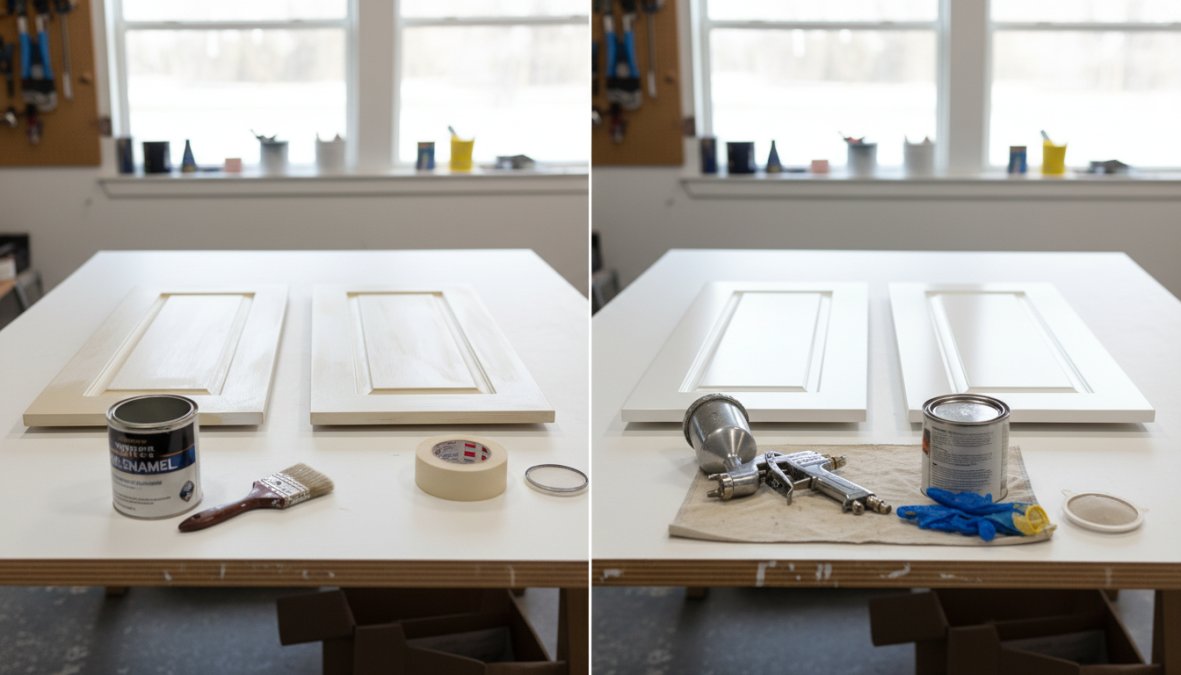
Here is the honest picture: DIY refinishing kits and YouTube tutorials make the process look accessible. What they do not show is the outcome six months later, after the finish has started peeling at the edges, or the brush marks that become more visible as the paint cures and flattens. The gap between DIY and professional results is not about effort. It is about equipment, materials, and technique.
The Role of Professional-Grade Tools and Spray Equipment
Professional cabinet painting requires spray equipment that most homeowners do not own and would not know how to calibrate. HVLP (high-volume, low-pressure) spray systems atomize paint into fine particles that lay down without brush marks, drips, or texture variation. The result is the factory-like finish that distinguishes professional work from DIY attempts.
Beyond the spray gun itself, professional applicators control the environment: temperature, humidity, dust contamination, and airflow all affect how a finish lays down and cures. A garage or kitchen with uncontrolled variables produces inconsistent results regardless of material quality.
The other equipment factor is surface preparation tooling. Professional sanders, orbital tools, and detail equipment reach profiles and corners that hand-sanding misses. Imperfections left in the surface telegraph through primer and topcoat, becoming more visible with each layer.
Surface Preparation Techniques That Make or Break the Finish
Surface preparation is where professional refinishing earns its price. The sequence matters: cleaning to remove grease and contaminants, sanding to create adhesion profile, priming with a bonding primer appropriate to the cabinet material, and then topcoat application. Skip or rush any step and the finish fails from the substrate up.
A common mistake in DIY refinishing is under-sanding. Cabinets that have been finished before, or that have a factory catalyzed finish, require aggressive mechanical abrasion before any new coating will bond. Many DIY applicators sand lightly, apply primer, and discover adhesion failures within weeks.
Professional applicators also know which primer to use for which substrate. Bare wood, previously painted surfaces, laminate, and thermofoil each require different adhesion chemistry. Using the wrong primer is the single most common cause of premature finish failure in cabinet refinishing.
Ask any cabinet refinishing company what primer system they use and why. A professional who can explain their primer choice for your specific cabinet material is demonstrating genuine expertise. A vague answer is a red flag.
Durability, Longevity, and Maintenance: What to Expect After Refinishing
A professionally refinished cabinet, done with proper surface preparation and a quality topcoat system, should perform well for a decade or more under normal kitchen conditions. Most articles stop there. This section goes further, because the longevity of your finish is not determined solely by what happens during the project, it is determined in roughly equal measure by what happens in the years after. What follows is a practical care guide built around the actual failure modes that bring refinished cabinets back for premature re-coating.
Understanding the Finish System You Have
Before you can maintain a finish correctly, you need to know what type of finish was applied. This matters because different topcoat chemistries have different care requirements and different failure modes.
Catalyzed polyurethane and conversion varnish finishes cure to a hard, cross-linked film that resists moisture, cleaning products, and impact well. These are the most durable options for kitchen environments and the most forgiving of routine cleaning. They are also the most common choice among professional cabinet refinishers working at the higher end of the market.
Water-based acrylic and alkyd-acrylic hybrid finishes are lower in VOCs and easier to apply in controlled environments. They perform well in most kitchen conditions but are somewhat more sensitive to prolonged moisture exposure and harsh cleaning products than catalyzed systems. Many professional-grade water-based products have closed the performance gap significantly in recent years.
Standard latex or consumer-grade finishes are occasionally used by less experienced contractors or in DIY applications. They are the least durable option for kitchen cabinetry and the most likely to show wear at high-contact points within two to three years.
Ask your refinishing contractor which system they used and request the product data sheet. This is not an unusual request, any professional should have it readily available, and it tells you exactly what you are working with for maintenance purposes.
The First 30 Days: The Critical Cure Window
The period immediately after a refinishing project is when the finish is most vulnerable, and most homeowners do not realize this. Even when a finish is dry to the touch within hours, full chemical cure, the process by which the coating reaches its maximum hardness and resistance, takes longer. For water-based systems, full cure typically takes two to four weeks. For catalyzed systems, the timeline varies by product but the principle is the same: the finish hardens progressively.
During this cure window:
- Do not use harsh cleaning products on the cabinet surfaces. Even mild abrasives can mar a finish that has not fully cured.
- Avoid prolonged moisture contact. Wipe up spills immediately rather than letting water sit against the finish.
- Be gentle with hardware. Repeated opening and closing with full force stresses the finish at hinge and pull points before it has reached full hardness.
- Do not place rubber mats or contact paper on cabinet interiors during this period. Some rubber compounds can react with uncured finishes and cause staining or adhesion issues.
Your refinishing contractor should give you explicit guidance on the cure window for the specific product they used. If they do not, ask.
The 10-Year Maintenance Guide: Year by Year
This is the care framework that most refinishing articles omit entirely. The goal is to keep a professionally applied finish looking and performing like new for a decade or more.
Ongoing (weekly to monthly):
- Clean cabinet surfaces with a soft microfiber cloth dampened with warm water and a small amount of mild dish soap. This handles grease, fingerprints, and cooking residue without stressing the finish.
- Dry surfaces immediately after cleaning. Do not let water sit on the finish, particularly at seams, edges, and around hardware cutouts where moisture can wick into the substrate.
- Avoid all-purpose spray cleaners, degreaser sprays, and any product containing ammonia, bleach, or abrasive particles. These degrade the sheen and, with repeated use, the film integrity of most topcoat systems.
Every 6 months:
- Inspect hinge points and pull locations for edge wear. These are the highest-stress points on any cabinet finish. Early wear at these locations is normal and manageable; ignored, it progresses to chipping and substrate exposure.
- Check the interior of base cabinets under the sink for any moisture intrusion. A slow leak that goes unnoticed can cause substrate damage that compromises the finish from below, and no topcoat can compensate for a deteriorating substrate.
- Tighten any loose hinges or hardware. Loose hardware creates micro-movement that stresses the finish at fastener points over time.
Every 1-2 years:
- Apply a thin coat of a finish-compatible cabinet wax or polish to high-use door and drawer fronts. This adds a sacrificial layer of protection over the topcoat at the surfaces that take the most contact. Use only products specified as safe for painted or lacquered surfaces, paste waxes designed for furniture work well for most professional finish systems.
- Inspect the finish under strong raking light (a flashlight held at a low angle to the surface works well). This reveals any areas of micro-scratching, sheen loss, or early adhesion issues that are not visible under normal lighting. Catching these early allows for targeted touch-up rather than full re-coating.
At 5 years:
- Have a professional assess the finish condition. A qualified refinisher can evaluate adhesion integrity, sheen consistency, and substrate condition in a way that is difficult to do without experience. This is not necessarily a sales call, a professional who tells you the finish is in good shape and needs nothing is giving you valuable information.
- Address any areas of edge wear or chipping with touch-up coating. Most professional refinishers offer touch-up services, and addressing small areas early prevents them from expanding into larger failures.
At 8-10 years:
- Evaluate whether a full re-coat makes sense. A professionally applied finish on a well-maintained cabinet can last well beyond ten years, but kitchen environments are demanding. If the finish shows consistent sheen loss, widespread micro-scratching, or adhesion issues at multiple points, a professional re-coat at this stage is far less expensive than it was originally, because the substrate is already prepared and the cabinet boxes are proven candidates for refinishing.
What Actually Causes Premature Finish Failure
Understanding failure modes helps you avoid them. The most common causes of premature finish failure in professionally refinished cabinets, in rough order of frequency:
- Harsh cleaning products used routinely. Ammonia-based cleaners and abrasive scrubbers are the leading cause of accelerated sheen loss and film degradation on painted cabinet surfaces.
- Moisture intrusion at edges and seams. Water that repeatedly contacts unsealed edges, particularly on MDF substrates, causes swelling and delamination that no topcoat can bridge.
- Insufficient cure time before heavy use. Cabinets put back into full service before the finish has cured adequately show wear at high-contact points within months.
- Inadequate surface preparation during the original project. This is the contractor’s responsibility, not the homeowner’s, but it is worth asking about before the project begins.
- Impact damage at corners and edges. Cabinet corners are vulnerable to chipping from pots, pans, and appliances. Edge protectors on base cabinet corners in high-traffic areas are a practical preventive measure.
Cabinet Material Compatibility: What Can and Cannot Be Refinished
Not every cabinet is a good candidate for refinishing, and understanding material compatibility is critical to a successful outcome, and to realistic longevity expectations.
Solid wood and quality plywood cabinets are ideal candidates. They accept adhesion well, hold fasteners firmly, provide a stable substrate for the finish system, and respond well to re-coating when the time comes. Longevity expectations for a professionally refinished solid wood or plywood cabinet are the highest of any substrate type.
MDF (medium-density fiberboard) can be refinished successfully when the surface is intact and edges are sealed. The vulnerability of MDF is moisture: swollen or delaminating MDF edges absorb water-based primers and expand, creating an uneven surface that telegraphs through the topcoat. Properly sealed MDF in good condition is a workable substrate; damaged MDF edges require repair or replacement before refinishing.
Laminate and thermofoil require specialized adhesion primers and careful mechanical preparation. Peeling thermofoil must be fully addressed before refinishing, the new finish will not bridge delamination, and attempting to paint over lifting thermofoil produces a finish that fails quickly. Laminate that is intact and well-adhered can be refinished with the correct primer system and produces good results.
Particleboard in poor condition is the one substrate where replacement often makes more sense than refinishing. Particleboard that has absorbed moisture, swollen, or lost structural integrity cannot be restored by surface refinishing. The finish may look acceptable initially but will fail as the substrate continues to degrade beneath it.
A professional assessment before project start identifies which category your cabinetry falls into. This is not optional, it is the step that prevents investing in a refinishing project on cabinets that are not suitable candidates, and it is the step that sets realistic longevity expectations for the substrates that are.
When your refinishing project is complete, ask your contractor for a written record of the primer and topcoat products used, including brand and product line. Store this with your home maintenance records. If you need touch-up work in three or five years, this information allows a contractor to match the original finish system precisely, which produces a far better touch-up result than guessing at a compatible product.
The longevity of a professionally refinished cabinet is a shared responsibility: the contractor is responsible for proper preparation and material selection, and the homeowner is responsible for correct maintenance afterward. A finish applied correctly and maintained correctly can perform well for a decade or more. The most common reason professionally refinished cabinets fail early is not the finish system, it is routine cleaning with products that degrade the topcoat over time.
Environmental Benefits, VOC Safety, and Eco-Friendly Refinishing
Professional cabinet refinishing is the more environmentally responsible choice compared to full replacement, and the case is straightforward. Replacing cabinets sends existing cabinetry to landfill, consumes new raw materials, and generates manufacturing and transportation emissions. Refinishing keeps existing materials in place and consumes only the coating system.
According to the Environmental Protection Agency’s guidance on construction and demolition debris, kitchen and bath renovation waste represents a significant portion of construction debris entering landfills annually. Refinishing eliminates that waste stream entirely.
The VOC (volatile organic compound) question is more nuanced. Traditional solvent-based finishes carry higher VOC loads, which affect indoor air quality during application and cure. Professional applicators using modern water-based topcoat systems apply products with significantly lower VOC content than older solvent systems. Many professional-grade water-based finishes now meet or exceed low-VOC standards.
The practical implication for homeowners: ask your refinishing contractor what VOC rating their topcoat system carries, and ensure adequate ventilation during application and the initial cure period. Professional applicators should be using respiratory protection and controlling the application environment regardless of VOC rating.
Eco-friendly refinishing is not just a marketing claim. The math on waste reduction, material conservation, and lower-VOC modern finishes makes professional refinishing the objectively greener choice compared to rip-and-replace renovation.
Color Selection, Custom Finishes, and Design Consultation
The design flexibility of professional cabinet refinishing is one of its most underappreciated advantages.
Full cabinet replacement limits you to manufacturer color offerings, which change with production runs and may not match your vision. Professional refinishing opens the entire paint color spectrum: any custom color, any sheen level from matte to satin to semi-gloss, and specialty finishes including glazing that adds depth and character to wood grain profiles.
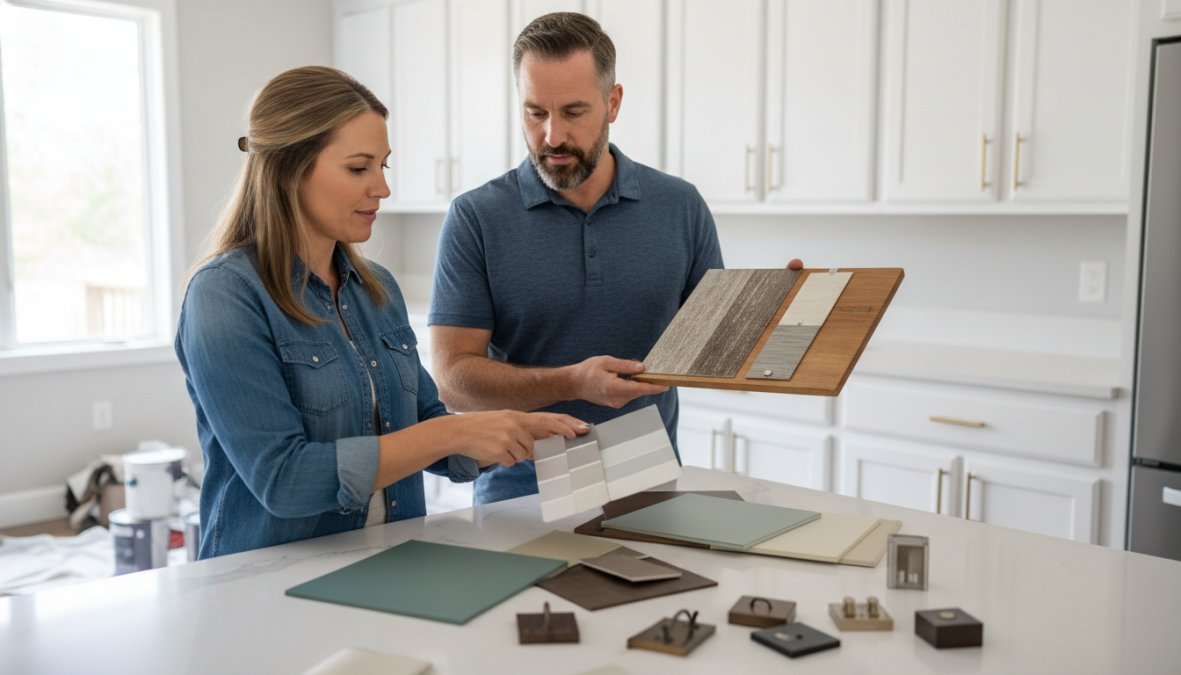
The sheen selection matters more than most homeowners realize. Matte and satin finishes hide surface imperfections better and reduce glare in high-light kitchens. Higher sheen levels are easier to clean but amplify any surface texture. A professional consultation helps match the sheen to the kitchen’s lighting conditions and the homeowner’s maintenance preferences.
Denver Cabinet Painting Colorado offers design consultation as part of its refinishing process, helping clients navigate color selection, finish type, and glazing options to achieve results that work with the kitchen’s existing elements. This is where 40 years of experience translates directly into better outcomes: knowing which colors photograph well, which finishes hold up in high-use areas, and which glazing techniques complement specific door profiles.
Custom finishes also extend to two-tone applications, where perimeter cabinets are finished in one color and the island in a contrasting shade. This approach has become a standard design move in higher-end kitchen renovations, and professional refinishing makes it accessible without the cost of new cabinetry.
How to Choose a Cabinet Refinishing Company You Can Trust
Choosing a cabinet refinishing company is where many homeowners make costly mistakes, and the selection criteria are more specific than most people realize.
Start with these evaluation criteria:
- Can the company explain their primer system and why it suits your cabinet material?
- Do they use professional spray equipment, or brush-and-roller application?
- Can they provide references from completed projects, not just before/after photos?
- Do they perform the work themselves, or subcontract to unverified crews?
- Are they licensed and insured for work in your state?
- Do they offer a written warranty on the finish?
- Is their quote itemized, showing preparation, materials, and application separately?
The single most revealing question to ask a prospective refinishing contractor is: "Walk me through your surface preparation process." A contractor who can describe cleaning, sanding, primer selection, and application sequencing in specific terms is demonstrating genuine expertise. A contractor who jumps straight to talking about color options and price is showing you where their priorities lie.
Experience matters in this trade. According to the Painting and Decorating Contractors of America’s professional standards, proper surface preparation is the foundation of any durable finish application, and it is the step most commonly compromised by less experienced contractors.
Denver Cabinet Painting Colorado has been serving residential and commercial clients across Colorado for 40 years, with a process built around meticulous preparation as the top priority. Free quotes are available, and the consultation process is designed to give homeowners a clear picture of the project scope before any commitment.
Conclusion: Is Professional Cabinet Refinishing Right for Your Home?
The question most homeowners ask at the end of this evaluation is whether their specific situation qualifies. The answer is yes in the majority of cases, provided the cabinet boxes are structurally sound and the surface is a compatible substrate for refinishing. The benefits of professional cabinet refinishing, from cost savings and resale value to environmental responsibility and design flexibility, make it the stronger choice over full replacement for most kitchens.
Outdated kitchen cabinets are one of the most common obstacles homeowners face when preparing a home for sale or simply wanting to enjoy the space they live in. Denver Cabinet Painting Colorado specializes in exactly this transformation, with 40 years of experience delivering smooth, consistent finishes for both residential and commercial clients across the Denver metro area and throughout Colorado. Their process prioritizes meticulous preparation and professional spray application, the two factors that determine whether a refinishing project lasts years or fails within months. Get a free quote from Denver Cabinet Painting Colorado and see what a factory-like finish can do for your kitchen.
Frequently Asked Questions
Is it better to refinish or replace kitchen cabinets?
For most homeowners, professional cabinet refinishing is the smarter choice. It typically costs a fraction of full cabinet replacement while delivering a factory-like finish that transforms the look of your kitchen. Unless your cabinet boxes are structurally damaged or warped beyond repair, refinishing preserves solid cabinetry, reduces landfill waste, and achieves results comparable to new cabinets, without the weeks-long disruption of a full kitchen renovation.
How long does professional cabinet refinishing last?
A professionally applied cabinet refinish can last 8 to 15 years or longer when properly maintained. Longevity depends on the quality of surface preparation, the type of topcoat used, such as a polyurethane or catalyzed finish, and how well the cabinets are cared for afterward. Avoiding abrasive cleaners, wiping up spills promptly, and using soft cloths for cleaning are simple maintenance habits that significantly extend the life of a professional finish.
How long does cabinet refinishing take compared to a full remodel?
Professional cabinet refinishing typically takes 2 to 5 days depending on the size of the kitchen and the number of cabinet doors and drawers involved. A full cabinet replacement, by contrast, can take several weeks and often requires coordinating multiple trades. The shorter turnaround time of refinishing means your kitchen is back in use quickly, a major practical benefit for busy households and commercial clients alike.
What is the difference between cabinet refacing and refinishing?
Cabinet refinishing involves cleaning, sanding, priming, and applying a new topcoat or paint to your existing cabinet surfaces to restore or change their appearance. Cabinet refacing goes further, it replaces the cabinet doors and drawer fronts entirely while keeping the existing boxes. Refinishing is the more cost-effective option and works well when cabinet doors are structurally sound. Refacing suits situations where the door style itself needs updating.
Can all cabinet materials be professionally refinished?
Most solid wood and plywood cabinets are excellent candidates for professional refinishing. MDF and some laminate surfaces can also be refinished with proper preparation and adhesion-promoting primers. However, thermofoil cabinets, which have a vinyl film wrapped over the substrate, are generally not good candidates because the film can peel and does not accept paint well. A reputable cabinet refinishing company will assess your cabinet material before recommending a course of action.
How do I choose a reliable cabinet refinishing company?
When evaluating a cabinet refinishing company, look for verifiable experience, a portfolio of completed projects, and clear communication about their surface preparation process. Ask whether they use professional spray equipment or brush application, what type of topcoat or primer they use, and whether they offer a warranty on their work. Companies with decades of experience serving your area, and a willingness to provide a free, detailed quote, are generally the most trustworthy choice.
This article was written using GrandRanker