Table of Contents
- How to Tell If Your Cabinets Are Worth Painting: A Decision Framework
- Assessing Cabinet Condition: Material-Specific Diagnostic Checklist
- Cabinet Painting Pros and Cons: When It Makes Financial Sense
- Best Paint for Kitchen Cabinets: Quality Matters for Longevity
- Signs Cabinets Need Repainting vs. Full Replacement
- Cabinet Painting vs. Refacing: Cost-Benefit Analysis
- Durability and Maintenance: What to Expect Long-Term
- Impact on Home Resale Value: ROI Considerations
Last Updated: July 20, 2026
How to Tell If Your Cabinets Are Worth Painting
Deciding whether to paint your kitchen cabinets requires honest assessment of condition, material, and long-term goals. At Denver Cabinet Painting Colorado, we’ve spent 40 years helping homeowners understand whether refinishing or replacement makes more financial sense.
This guide walks you through a practical framework for evaluating whether your cabinets are candidates for refinishing or whether replacement makes more sense.
The Three Key Questions to Ask First
Before calling a cabinet painter or pricing replacements, answer these three questions honestly.
Question 1: What condition are the cabinet boxes themselves in? Open a door and check the frame for water damage, warping, or structural issues. If the boxes are sound, painting is viable. If the substrate is compromised, no paint will fix it.
Question 2: How old are your cabinets, and what material are they made from? Solid wood cabinets from the 1990s or earlier handle multiple paint cycles and last decades with proper care. Laminate or MDF from the 2000s onward has a shorter refinishing lifespan. Particle board cabinets are poor candidates because the material doesn’t accept paint adhesion well.
Question 3: What’s your timeline and budget reality? Professional cabinet painting takes 2-4 weeks. DIY painting is cheaper upfront but often fails within 12-18 months without meticulous surface prep. Full replacement takes longer but eliminates future repainting.
Assessing Cabinet Condition: Material-Specific Diagnostic Checklist
The material your cabinets are made from determines whether painting will hold up long-term.
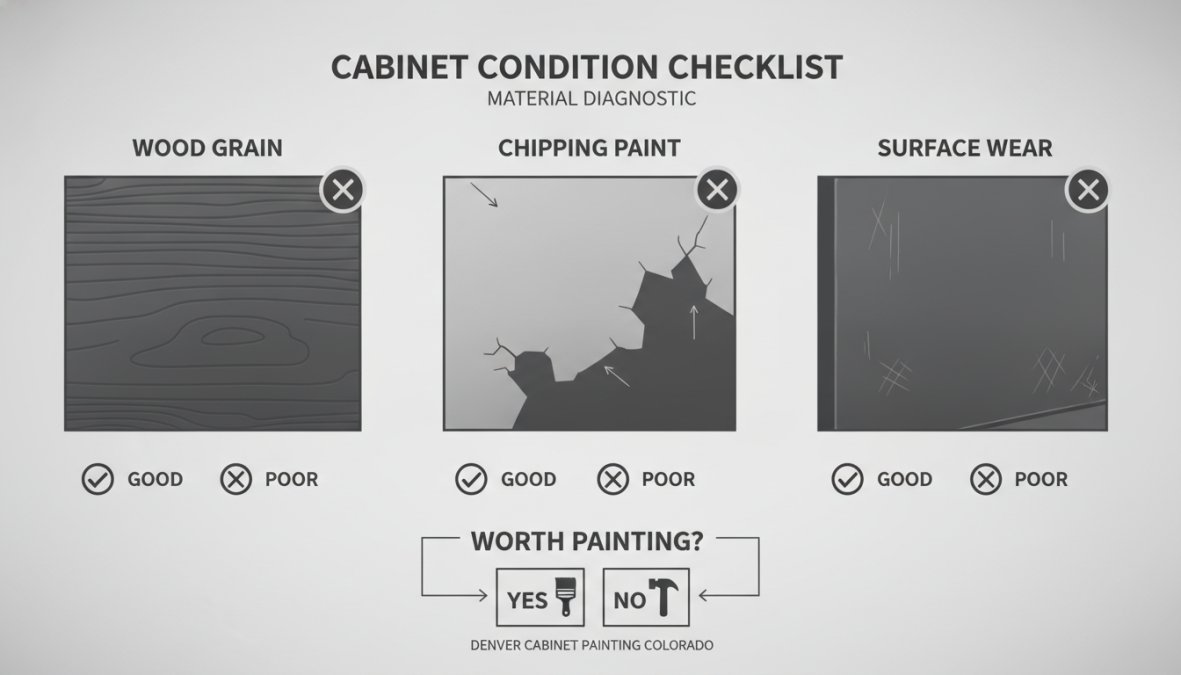
Oak Cabinets: What to Look For
Oak cabinets from the 1980s and 1990s are excellent painting candidates because the wood accepts primer and paint well.
Check for water damage around the sink area. If the wood feels soft or spongy near hinges or drawer fronts, the damage runs too deep for painting. Press your fingernail into the wood grain; if it leaves an indentation, the wood is compromised.
Examine the existing finish. If the current stain or varnish is peeling or flaking, that’s positive for painting, the old finish is ready to come off and fresh primer and paint will adhere better.
Oak’s open grain structure requires a quality primer to prevent paint from soaking into the wood. Cheaper primers fail within months. This is where professional painters earn their fee, they know which primers actually work on oak versus which ones create peeling surfaces within a year.
MDF and Laminate: Unique Challenges
MDF and laminate cabinets from the 2000s and 2010s are trickier to paint because these materials don’t accept paint the same way solid wood does.
For laminate cabinets, the critical question is whether the laminate is intact. Run your hand over the surface. If you feel edges lifting, bubbling, or peeling, painting won’t solve the problem. Paint will peel off lifted laminate because there’s no solid substrate underneath.
MDF cabinets are softer than solid wood and dent more easily. If your existing MDF cabinets show significant dents or gouges, painting will highlight those imperfections. Minor dings can be filled with wood filler before painting.
The real issue with both materials is paint adhesion. These surfaces are slick and paint doesn’t grip naturally. If the original painter didn’t sand aggressively and use the right primer, paint will peel within 12-18 months.
Check the edges of cabinet doors on laminate cabinets. If edge banding is damaged or peeling, it will need replacement before painting. Edge banding costs roughly $3-8 per linear foot.
If your laminate cabinets show bubbling, lifting, or peeling anywhere on the surface, painting is not viable. The laminate substrate is failing, and paint cannot adhere to a failing surface.
Cabinet Painting Pros and Cons: When It Makes Financial Sense
Painting cabinets transforms a kitchen’s appearance at a fraction of replacement cost.
Advantages of Cabinet Refinishing
Cabinet painting delivers dramatic visual impact. A dated oak kitchen from the 1990s becomes modern when painted in contemporary colors.
The cost advantage is real. Full cabinet replacement runs $15,000-$50,000. Professional cabinet painting typically costs one-third to one-half of that.
Painting preserves your existing cabinet layout and hardware compatibility. You don’t need to reconfigure anything. Full replacement means new cabinet boxes, hardware, and often new countertops or backsplash.
The timeline is shorter. Professional cabinet painting takes 2-4 weeks. Full replacement takes 4-8 weeks, often with unexpected delays.
If your cabinets are structurally sound but stylistically dated, painting is almost always the right choice. The cost-to-impact ratio is unbeatable, and you’ll enjoy the results for 7-10 years with proper maintenance.
When Painting Falls Short
Painting doesn’t fix structural problems. If your cabinet boxes are warped, water-damaged, or doors don’t close properly, paint is cosmetic.
Paint hides imperfections temporarily but doesn’t eliminate them. Dents and gouges become more visible under fresh paint.
Painting requires ongoing maintenance. The finish will eventually wear, chip, or peel depending on use. A painted cabinet finish typically lasts 7-10 years before needing touch-ups or repainting.
For severely damaged laminate or particleboard cabinets, painting is a temporary solution. If your cabinets are already 15+ years old and made from budget materials, you’re investing in a short-term fix rather than a long-term solution.
Best Paint for Kitchen Cabinets: Quality Matters for Longevity
The paint you choose determines how long your cabinet finish will last and how resistant it is to daily kitchen abuse.
Kitchen cabinets require paint designed for high-traffic, high-moisture environments. Standard interior latex paint will fail within months because it’s not formulated for temperature swings, humidity, and physical contact that cabinets endure.
Cabinet-specific paints fall into two categories: lacquer and enamel. Lacquer dries faster and produces a harder, more durable finish. Professional painters typically use lacquer because it resists chipping better. Enamel is more forgiving for DIY application but takes longer to cure.
The primer is equally important as the paint. Cabinet surfaces require a bonding primer that grips the existing finish. Skipping quality primer is the single biggest reason DIY cabinet painting fails. A quality bonding primer costs more upfront but prevents peeling that will cost you thousands in repainting.
Look for paints labeled specifically for cabinets or trim. A quart of quality cabinet paint costs $25-50. Cheap paint costs $8-12. The difference compounds when painting 30+ cabinet doors and dozens of drawer fronts.
Signs Cabinets Need Repainting vs. Full Replacement
Understanding when your cabinets have reached the end of their painted life helps you avoid pouring money into a failing project.
Red Flags That Painting Won’t Help
If cabinet doors don’t close properly or hinges are bent, painting won’t fix the mechanical issue. If this is widespread, it signals the cabinet boxes themselves are warping.
Water damage visible inside cabinet boxes is a red flag. Look under the sink and inside lower cabinets near appliances. If you see dark staining, soft spots, or mold, the wood is compromised. Paint cannot seal water damage.
Laminate that’s bubbling or peeling is beyond painting. The substrate is failing.
Particleboard cabinets that are sagging or warping are at the end of their life. Particleboard absorbs water and swells, compromising structural integrity.
If your cabinets are more than 20 years old, made from budget materials, and showing multiple signs of wear, replacement is often more economical than painting.
If you’ve already painted your cabinets once and the finish is peeling or chipping significantly within 3-5 years, the underlying preparation was poor. Professional evaluation is necessary before a second paint job.
Cabinet Painting vs. Refacing: Cost-Benefit Analysis
Refacing is a middle ground between painting and full replacement. You keep the cabinet boxes and replace the doors, drawer fronts, and veneer.
Refacing costs more than painting but less than replacement. Expect to pay 40-60% of full replacement cost.
Refacing makes sense when your cabinet boxes are solid but the doors and fronts are damaged beyond painting. Painting makes more sense when your existing doors are structurally sound and you like their style but not their color or finish.
Both are interim solutions. Full replacement is the only option that resets the cabinet lifespan entirely.
Durability and Maintenance: What to Expect Long-Term
Painted cabinets require maintenance to keep the finish looking good and lasting as long as possible.
Maintenance Expectations by Paint Type
Lacquer finishes, which professional painters typically use, are harder and more durable than enamel. A lacquer-painted cabinet can go 7-10 years before needing touch-ups if maintained properly.
Enamel finishes, common in DIY projects, require more careful handling. Enamel-painted cabinets typically need touch-ups or repainting within 5-7 years.
Daily maintenance matters significantly. Wipe spills immediately and don’t let water sit on the painted surface. Use a soft cloth and mild soap and water for cleaning.
Moisture is the enemy of painted cabinet finishes. Ensure your kitchen has adequate ventilation. Use your range hood when cooking.
Set a reminder to inspect your painted cabinets annually. Look for chipping, peeling, or areas where paint is wearing through. Catching problems early prevents small issues from becoming major failures requiring full repainting.
Hardware and Hinge Compatibility
Your existing cabinet hardware will likely need replacement when you paint. Original hardware from older cabinets often doesn’t match modern aesthetic preferences.
Soft-close hinges and drawer slides are now standard in quality cabinet work. They cost more than basic hinges but dramatically improve the user experience.
Hardware replacement adds to the total project cost. Budget $50-150 per cabinet for new hardware. A 15-cabinet kitchen could easily run $750-2,250 just for hardware.
Impact on Home Resale Value: ROI Considerations
A fresh coat of paint on tired cabinets improves kitchen appearance significantly, which affects how potential buyers perceive your home.
Kitchen appearance drives buyer perception more than any other room. Dated cabinets make an otherwise nice home feel old and tired. Fresh, modern cabinets make the same home feel updated and well-maintained.
The actual return depends on your market and the quality of the work. A professional paint job that looks high-quality and modern will recover 50-80% of the investment at resale. A poor DIY paint job that’s peeling or uneven will actually hurt your resale value.
If you invest $5,000 in professional cabinet painting, you might recover $2,500-4,000 of that at resale. Full cabinet replacement recovers only 30-50% at resale because buyers expect to choose their own cabinet style.
If you’re planning to stay in your home 5+ years, the ROI calculation shifts. You’re buying for years of enjoyment, and a painted kitchen that looks great is worth the investment for your own quality of life.
Determining whether your cabinets are worth painting requires honest assessment of their condition, material, and your goals. The pattern is clear: solid wood cabinets in good structural condition almost always benefit from professional painting. The combination of meticulous surface preparation, quality primer, and durable cabinet-specific paint creates a finish that lasts 7-10 years and transforms your kitchen’s appearance at a fraction of replacement cost. If your cabinets pass the structural integrity test and your kitchen layout works for you, painting is the smart choice.
Frequently Asked Questions
We tried painting our cabinets ourselves and it started peeling within months, why would professional cabinet painting be different?
DIY peeling typically results from inadequate surface preparation, wrong primer selection, or low-quality paint. Professional painters perform thorough degreasing, sanding, and primer application to ensure paint adhesion. They also use commercial-grade enamel or lacquer formulated for cabinet durability, not consumer-grade options. Proper surface prep is 80% of the job, skipping it guarantees failure. Professional painters invest time in preparation that most homeowners skip, which is why the finish lasts.
How do I know if my old cabinets are worth painting versus replacing entirely?
Assess structural integrity first: if cabinet boxes are solid and doors/drawer fronts operate smoothly, painting is usually viable. If you see water damage, rot, significant warping, or loose joints, replacement may be necessary. Material matters too, solid wood and quality MDF accept paint well; damaged laminate often cannot. Consider the cost difference: painting typically costs significantly less than full replacement. If your cabinets are structurally sound but dated, cabinet refinishing can transform them cost-effectively.
What's the actual difference in cost between painting cabinets and replacing them?
Cabinet painting is generally more budget-friendly than replacement, but exact pricing depends on cabinet quantity, condition, paint type, and labor rates in your area. Factors affecting cost include surface preparation complexity, whether hardware needs updating, and whether you choose professional application or DIY. For a detailed cost comparison specific to your project, contact Denver Cabinet Painting Colorado for a free quote. They can assess your cabinets and provide transparent pricing based on your specific situation and goals.
How long do painted kitchen cabinets actually last before needing repainting?
Well-executed cabinet refinishing with proper surface preparation and quality enamel or lacquer paint typically lasts 3-5 years with normal kitchen use, or longer with excellent maintenance. Durability depends on paint type, application method, humidity, and kitchen traffic. Professional finishes last significantly longer than DIY attempts because of superior paint adhesion and coating thickness. Regular cleaning and avoiding harsh chemicals extends cabinet life. If your previous DIY attempt failed quickly, professional-grade materials and application techniques will deliver dramatically better longevity.
This article was written using GrandRanker